SPOILERS BELOW.
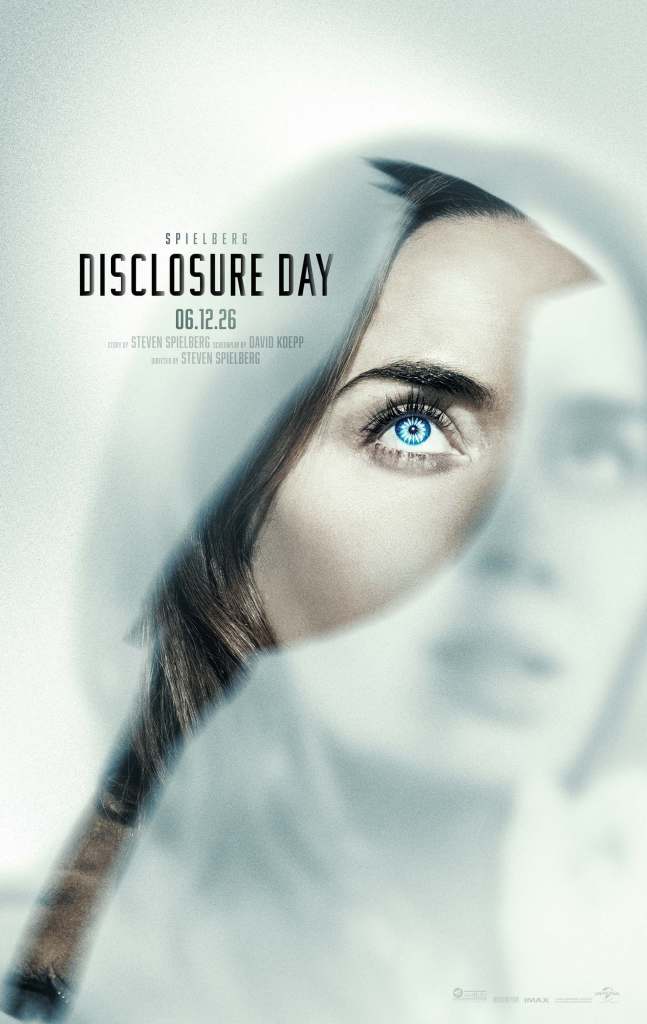
Tyler: Norman, tonight I saw Disclosure Day. I don’t know where to begin. I’m reeling.
Norman: I have had a night to sleep on it. Not so much reeling. Feeling reflective about Spielberg and how this fits into his life’s work. It seems like a distillation of sorts.
Tyler: <time lapse>
We’re even. Loom readers, for reference, Norman and I now compose our dialogues through the exchange of e-mails. I wrote Norman my initial response last night a little after 10:30, fresh from the movie, in a bit of a fugue state. It’s been a day now and I remain amazed. There is so much in this film. A beautiful, stunning density.
Distillation is a fine word for it. This is a motion picture giving us high-velocity thrills, car chases, moving-train escapades, melded to some of the most directly incendiary and effective polemic I can recall from a modern Hollywood production.
Conceptually, thematically, and in execution, I haven’t seen anything like Disclosure Day. It set me alight.
Norman: I should clarify what I meant by “distillation.”
Steven Spielberg has been making movies about aliens for most of his career. Science fiction is the genre he returns to most often. If The Fablemans was a summary statement about his upbringing, his deeply-rooted concerns about family, and filmmaking itself, Disclosure Day is a summary statement on the genre and subject he loves so much. It takes most of his thematic preoccupations and crams them into one 145 minute thrill ride. The most obvious point of comparison is Close Encounters of the Third Kind, which is one of the prime examples of “personal genre movie” in all of film history.
Disclosure Day is the Spielberg of Spielberg movies. And I mean that for better and worse. Tyler, I have no interest in dampening your enthusiasm for Disclosure Day, but I’m still wrestling with it. Like you, I was astonished, but only in part. Unlike you, I found myself frustrated with certain elements, especially in the film’s final act.
Let’s dig in. What struck you about this late-period Spielberg thing we call Disclosure Day?
Tyler: I’ll readily concede that I too struggled at times with that final act. For now, I’m placing my faith in Spielberg’s unusual choices, as the grand effect of the film is so potent. I do plan on seeing this one a second time with those concerns in mind, as there were moments in the theater this first time around wherein, yeah, I thought “oh boy, Steven, are we losing the plot here?”
I think I’m falling in love with Disclosure Day nonetheless. As the train sequence unfolded, a broad sense of pleasure settled over me. “This is the work of a master. We’re in good hands.” Such a comfort, that feeling.
Atop that, this to my eye is far from just a thrill ride. It’s a raging piece of political cinema, ferocious and exasperated and unafraid to take a side. I love that about it! Has Spielberg ever been so directly revolutionary? I’m not being hyperbolic. We are in dire times and Spielberg has a claim to being the greatest American director in cinema history. It was fair to expect a political shade. Nothing, though, so incendiary as this.
Norman, you make a fair point in declaring Disclosure Day the “Spielberg of Spielberg movies.” I think we may be dealing with something even more extraordinary, though: the Scorsese of Spielbergs.
Norman: The “Scorsese of Spielbergs” has already happened. That was back in 2005 with Munich, the most overtly political and darkest movie in his whole body of work. But, yes, Disclosure Day is staking out a distinctly conspiratorial vision of the world. A conspiracy, mind you, meant to keep mankind from wonder, awe, discovery, and harmony.
In service of that vision, Disclosure Day is nothing if not captivating from start to finish. It has at least two bona fide classic set pieces. The first is the aforementioned train sequence. The second, if I’m not giving away too much, involves a sort of disappearing house. There is literally no one as capable of ratcheting up tension through brilliant filmmaking.
But I’d like to air my grievance with the film before going any further. For that I need to talk about the final act of the movie. Reader, beware. I never ever ask for a movie to be “realistic.” Movies, like any other narrative art, are meant to reflect, distort, and twist reality in order to help us better understand reality. And, anyway, this is a movie about aliens and a magic metal stick thingy. But I do want a movie to make internal sense. And for as political as Disclosure Day is, I want it to meet the moment head-on. So, here’s my problem. Disclosure Day wants us to believe that the world would, with childlike innocence, take the alien video feed from a Kansas City local news affiliate as holy writ. It wants us to believe that the world would actually believe this. In the age of AI deepfakes, I’m afraid that only the most gullible would bother to pay the slightest bit of attention. Spielberg is a man full of hope and wonder. But for this political moment we needed a bit of cynicism. We needed someone in the crowd to say, “Oh for fuck’s sake, I could make that video with ChatGPT.”
This movie comes to us at a time when the Trump administration recently declassified UFO material and the impact on our world and its frenzied news cycle has been a total dud. No one cares. The only way that the world would take Emily Blunt, the local KC weather woman, seriously is if a bunch of spaceships across the world all came down and rested, Arrival style, for everyone to see with their own eyes.
While Disclosure Day wrestles with the great philosophical implications of a potential disclosure, the movie hit me like a pure fantasy.
Tyler: <time lapse again>
Now I’ve seen it twice. I reckon, my friend, the film is less fantasy than parable. It also knocks out the AI question within the disclosure sequence, as a tech in the NBC control room confirms via “deconstructor” or something that the videos are not artificial. It’s a quick aside of an exchange, but it is there.
I also reckon that doubt would be undercut by the sheer volume of revealed footage. The dazzling shots of soldiers and commuters and everybody across the world staring into their phones, boy, I think they’re brilliant. What a payoff! Spielberg wants us to look up from our devices, but he recognizes that we usually don’t. Not for nothing is Disclosure Day‘s very last image of Emily Blunt through a camera, and not a direct unimpeded medium shot. That’s how we see the world here in 2026, through lenses and screens.
Now, I’m not saying that the world within this film would legitimately change after that exquisite final line. Perhaps apocalyptic conflict would nonetheless ensue. Likely, the aliens would be exploited even further—humanity is so cruel and beastly, and empathy in our age is so virulently scorned. I do contend, though, that Spielberg is aware of all this, and that he still chose to end his grand work on a note of hope because he really believes in the concluding directive. I also think he thinks he can really make a difference with this motion picture. He can’t save the world, but he can maybe, just maybe, change minds.
How can he believe so boldly? Well, for one, he’s Steven Spielberg, perhaps the only filmmaker on this planet with the Hollywood swing enough to make so widely-dispersed a work as vital and important as Disclosure Day. Atop that, though, this is a movie about belief. It’s run through with discussions about faith. One of the primary characters is a former novitiate, and the principal adversary is quick to quote from Scripture. There’s even a nod to stigmata, inflicted by of all things a crucifix. People pray in this movie. People believe. Faith in supreme beings holds civilizations together, Jane declares, contrarily doubting humanity’s ability to accept and process legitimate proof of higher creations. I’m not with Jane on this one, brother Norman, and I have to disagree with you. We have cynicism in abundance. Even as a lapsed Catholic who religiously functions at most as agnostic, I in this instance have faith. Disclosure Day, to my soul, is a spiritual experience.
I mean, the crayons! My God, what a magnificent touch. The regular photographic use of down-facing shots from above. Blunt’s performance, sure to lock down nominations by the bushel. Colin Firth, fantastically throwing around bearded majesty and scorn as if Spielberg told him to channel Orson Welles—Firth’s muted, clipped reference to medical equipment as “non-sunse,” oh, I eat it up with a spoon—all while allowing even his antagonist considerable empathy. Josh O’Connor, perfectly tortured as Daniel. Eve Hewson, Jane, surging with philosophy and vigor. Colmon Domingo as Hugo! Courtney Grace, an actress who doesn’t even have a Wikipedia page, brings it all together as audience surrogate in the final scene. Oh, mercy, damn near everyone is note-perfect. The only lump saddled with a bum ride is Wyatt Russell, who endures the thankless role of Blunt’s boneheaded boyfriend, his presence just revealing enough to make the part essential. Maybe I wish Russell’s character was even the slightest bit more sympathetic. Honestly, though, the movie is so good that I just don’t care.
Norman, you’re a pastor. You and I have talked of faith frequently, in our articles as well as in life. I am grateful, honored, blessed, to share this forum with you, discussing this movie. I saw it for that second time, earlier this evening. My thoughts are clearer; my admiration even fuller. Disclosure Day is a moral and artistic triumph of a picture. More colloquially, I’ll repeat what my mind repeated to me, over and over, as my left hand gripped my girlfriend’s despite my full knowledge of what was to come: “This is fuckin’ badass.”
Norman: Until I see Disclosure Day again, we will be in sharp disagreement. I like how you’ve pointed out how the movie acts as a sustained meditation on belief itself. This was intriguing to me as the movie went along, but eventually collapsed in on all of my personal sensibilities. Whenever we believe (or disbelieve) in something, it usually changes how we live, at least to some degree. The question of aliens is similar to the question of God. If you entertain the possibility of God in an agnostic sense, it probably won’t make any major difference in how you live. It’s only when you believe in a specific God, one that has claims on your life and your moral reasoning, that things get serious. When it comes to aliens, I’d label myself as an agnostic. They could be out there, they could not be out there. Who knows. The real question is this: if they are out there, what are they like? The answer to this question is what would change me. It would determine how I react and maybe change my theological and metaphysical convictions. The mere existence of aliens means nothing until they are tangible. The aliens in Disclosure Day are barely involved. We don’t ever know what they are all about, unless you count that one word at the end. But even that one word is meaningless without any context from the aliens themselves.
I’ll be blunt. While I love that Spielberg is willing to go all in on exploring belief, I find much of these ruminations on faith to be shallow and naive. It may not be fair to one of our great directors, but I couldn’t help but compare Disclosure Day to one of my favorite novels, The Sparrow by Mary Doria Russell. It is a tale about a Jesuit mission to an alien colony. What the Jesuits encounter when they arrive on the new planet isn’t quite what they expected and it changes them profoundly. But it isn’t the idea of aliens that changes them; it’s the aliens themselves. By the end of Disclosure Day, I felt let down. As if I had been led through all the tantalizing pleasures of foreplay only to be told that we have to stop just when things are getting hot and heavy.
Tyler: I suppose, given that analogy, that you were frenzied with youthful lust watching Alien Nation.
I kid! I must say, this is a rare occasion, my hearty celebration of a film countered by a skeptical take from you. It’s usually the other way around. This way certainly works out better for me!
Norman: It does! Despite my skepticism, I will say this: Disclosure Day, for all the flaws I find in it, is better than 90% of the movies that come out these days. There are great sequences and good acting. It’s willing to raise questions that the average blockbuster wouldn’t even dream of entertaining. This might not be top tier Spielberg for me, but it’s still Spielberg!
Tyler: In Steven we trust.

