Spoilers below.
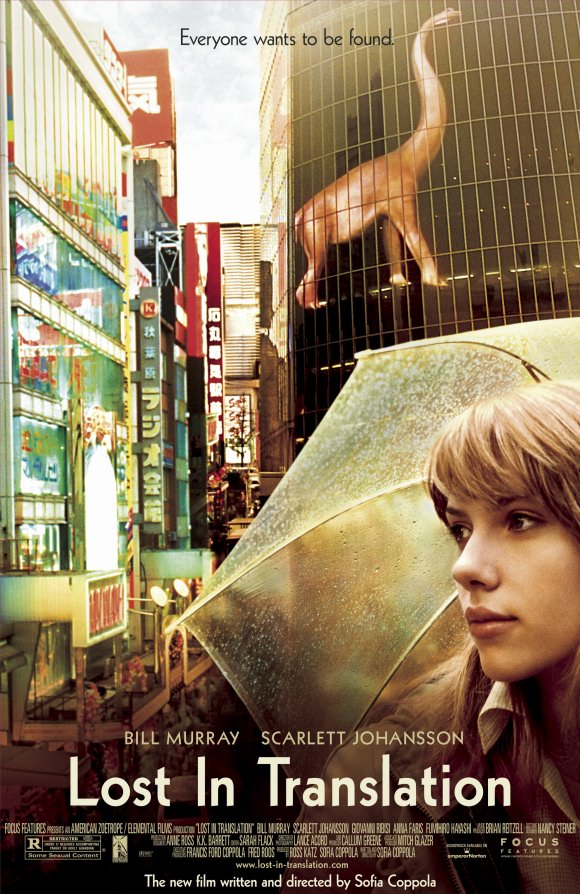
Norman: The opening shot of a movie will sometimes act as a key to what follows. The themes, ideas, and even structure of the film can be embedded in that one opening salvo. In Sofia Coppola’s Lost in Translation, the first thing we see is Charlotte’s (Scarlett Johansson) ass in see-through underwear as she lies on her side on a hotel bed. A dim light illuminates the scene. When I first saw Lost in Translation during its initial theatrical run, I was confused. What did this image have to do with anything? Coppola never ties it to anything else happening in the movie, so there’s no narrative point here.
But consider the image – in a thoughtful way, you horndogs! Charlotte is not naked, but neither is she dressed to go out in public. She’s in bed, but there are no blankets or covers. Is she awake or asleep? The light is on, but it is low. The image, which is very nearly a still photo, is sumptuous. The shape of her body is lovely, the sense of rest is inviting. Most likely, Charlotte is in the liminal space we call “jet lag.” The body is exhausted but habituated to time on the other side of the world. Sleep is desired, but it will not come. It is this kind of space, the “in between,” that Lost in Translation explores so well. What struck me as bizarre and unexpected at first, now strikes me as a perfect opening shot.
When people inhabit liminal space, they are afforded the opportunity to reconsider the space they already know. Their homes, their work routines, and even their most cherished relationships come under the harsh light of a new place that might offer new possibilities. Going to a new country dislocates your sense of self, allowing you to try on different personalities, perspectives, and even relationships. Liminal space, by nature, can’t last forever. You will return to your life soon enough. And when you return, that sense of dislocation and dissonance will linger for a while. You’ll reflect on your time in liminal space and wonder if it was a dream.
Few movies attempt to depict liminal space. Lost in Translation imagines that liminal space through two Americans, one a middle-aged actor reduced to playing the part of a whiskey sponsor and the other a naive recently graduated philosophy major. Both feel disconnected from their spouses, and so, left alone in Japan, they start an unlikely relationship that feels both fresh and dangerous.
Tyler, I’ll come out and say it now: I’m a huge fan of this movie. I enjoyed it when it was first released and revisiting it again years later, I was delighted to find that Lost in Translation is still unlike any other movie I’ve seen.
Tyler: I adored Lost In Translation for a very long time. Saw it in the theater upon its initial release in 2003, and was so struck by the work that the next installment of my college-paper pop culture column was a dramatic celebration of what I’d experienced. “It is a masterpiece,” I wrote, “a hilarious, heartbreaking watercolor of a picture, tracing in feathery brushstrokes its inimitable characters, its remarkable setting.”
Faint praise! That immediate enthusiasm carried through over a good many years, DVD copies of the film earning many, many replays. Revisiting it now, I was often a few steps ahead, my memory of the motion picture as worn-in as that of a beloved old song. From that provocative first shot, to the concluding fade after our protagonists part ways, I found myself comforted by the familiarity of it all. I turned to Lost In Translation for solace quite a bit in my twenties and early thirties. It gave me plenty, and for that I owe the movie and its creators a debt of gratitude.
A shame, then, that I now viscerally detest so much of it. Lost In Translation is a sour valentine to judgemental cynicism. Johansson’s Charlotte and Bill Murray’s Bob spend their time onscreen, together and apart, mocking and getting frosty with seemingly everybody around them. Nobody escapes their withering sighs and guffaws. Charlotte’s primary target, Kelly—played by Anna Faris and directed by Sofia Coppola as a clear and very mean-spirited takedown of Cameron Diaz—amuses recent Yale graduate Charlotte by not knowing the gender of author Evelyn Waugh, an offense we’re supposed to find indefensible. Kelly also karaokes “Nobody Does It Better” in the hotel bar, sending Charlotte into vicious hysterics, as if Kelly’s performance is any more or less ridiculous than Charlotte in a bright-pink bob-wig at an apartment party cooing “Brass In Pocket” to a man twice her age. Coppola and Faris even have the gall to suggest that the character is so helpless as to pronounce Cuba, “Coo-ba,” a ridiculous creative decision, not least if the same character can discuss her father experiencing torture after capture at the Bay of Pigs. None of this holds up as humorous; all of it reflects poorly on each principal involved, from Coppola on down. Hell, Sofia even puts her own spouse against the wall, directing Giovanni Ribisi into an obvious evocation of Coppola’s then-husband Spike Jonze. John, as Ribisi plays him, is a bit twitchy, ostensibly “quirky,” and all too besotted with his dissatisfied wife Charlotte. For so many years I laughed with Charlotte at her hubby, dismissing his photographer’s vision and his willingness to hang out with Kelly. That’s nonsense, though. John’s the good guy here. Charlotte’s a brat. Johansson’s performance is natural, no doubt, a wonder. Coppola foregrounds her beauty, her sensuality, from that very first shot and onward, setting Charlotte’s body repeatedly against backdrops of concrete cityscape, coyly dressing the character down when she ventures out of the hotel, but Johansson anchors the display with honest-to-goodness acting. She holds her own against Bill Murray at his best. No small feat.
Murray is a triumph as well, though his character is as detestable as Johansson’s. Bob pushes away his wife of twenty-five years, a woman named Lydia whom we’re only allowed to hear in weary, wit’s-end tones, through Bob’s phone, buried in the film’s sound mix. Lydia has her own stationery, tries to engage with her husband by building him a new study, and raises their kids increasingly on her own—what a hen! So offensive are these traits that we’re supposed to immediately forgive Bob cheating on her, giving him a pass because that ol’ ball-and-chain, am I right? “I don’t want all that pasta,” a bathing Bob barks into his cell at his wife across the world, declaring to her that he wants to eat like the Japanese. She asks him, in no uncertain terms, why don’t you just stay there? Norman, brother, she’s earned that retort. Bob’s very witty, and has very sad eyes, but he’s not a good dude. He’s had plenty of time to decide what kind of person he wants to be, and he’s opted out of some very basic responsibilities. “Your life as you knew it is gone,” Bob says of the day a parent has their first child, “Never to return.” Bob didn’t get his own memo, though, as he’s drinking every night in the hotel bar, infatuated with a young married woman with a cruel streak. These aren’t the things most grown fathers can get away with, but Bob can, so he does. Just because it’s Bill Murray doesn’t mean it’s right.
So much of this bothers me, but, really, Coppola’s grossest transgression is the reduction of Japan and its people to a punchline, over and over and over and over and over and over and over again. Lost In Translation is not a love letter to a country. It’s a sequence of offensive dialogues and setpieces, all of which are designed to make the Japanese look bizarre and ridiculous when compared to Bob and Charlotte and their wry American poise. It’s appalling, and it has no place in modern cinema, not least a film as highly regarded as this one. We’re supposed to look at a telecast of, what, somebody eating noodles comically, and think it an affront to common humor and decency? Are our American talk shows and our arcades particularly different from those Bob and Charlotte experience? My God, the sushi bar scene wherein Bob cracks wise about serving “brack toe?” Enough already. Lost In Translation doesn’t deserve its reputation as a bridge between cultures. If anything, it wants nothing to do with the land it portrays, because, even at the temple, Charlotte didn’t feel anything.
Norman, to your point, Lost In Translation is unlike anything else I’ve seen as well, two times over. So very long ago, it seems, I fell for that glow. Lifetimes later, then, I saw beyond the lighting. This is a stupendously-crafted movie, my good and cherished friend. There are fine moments, there are inspired exchanges, the finale retains an undeniable power. But this is no movie to cheer. I loved it. Now I lament.
Norman: You came in hot on this one! I see I’m going to have to fend off your objections!
One of the biggest dilemmas in movies is whether a character needs to be good or admirable to be sympathetic. Bob and Charlotte are not the best people. She is immature and unreasonable. He is just an older version of immature and unreasonable. They both have spouses who appear to be mature and reasonable. But I can’t bring myself to judge the movie because its principal characters are petty brats. In fact, I think their brattiness is part of what makes the movie work. It works because Coppola never lets them have an epiphany. They remain immature to the very end.
Late in the movie Charlotte and Bob have an icy meal where they expose each other’s faults in bitter terms. This is a clear signal that Coppola knows exactly who Bob and Charlotte are. It is a virtue for a writer to create characters they know are unpleasant, but refuse to judge them or ask us to judge them. Watching the movie this time, I saw a bit of my younger self in Charlotte: adrift, judgemental, lacking confidence and direction. In Bob I could see my own tiredness.
As for Japan, I think Coppola gets it right. At least right through the eyes of someone passing through. When you visit another culture, everything is strange and little makes sense. You find some aspects of the culture charming and others bewildering. You really do not know how to order in a restaurant. Communication can be a nightmare. In Japan you might not realize that you do not place money directly into the cashier’s hand. Instead, you put it in a little basket and the cashier slides the basket back with your change. And then you feel stupid for not realizing that they do it different here, but you also register the practice as simultaneously sensible and really weird. I honestly don’t think Coppola is condescending to the culture or making it into a punchline, but rather giving an accurate expression to the experience of navigating a culture you simply do not comprehend.
I do think you are right about Anna Faris’ character. I did not know that it was directed at Cameron Diaz, but it was not hard to tell that Coppola had nothing but pure vitriol for the character. Every time she appeared on screen I didn’t just feel bad for the character but also for every actor or actress who isn’t as hipster cool as Sofia.
That minor flaw aside, I stand by my love for Lost in Translation. If anything, having been to Japan for a brief visit, I love it more now.
Tyler: I appreciate your experience in Japan. I’m certain that it enhances Lost In Translation‘s theoretical charms, much as, say, a minor league ballplayer might savor Bull Durham more personally than your average cinemagoer. I’ve long been curious about Japanese culture myself, dating to a pre-adolescent appreciation of Dave Barry Does Japan, and tracing through a course I took freshman year of college, an intro to East Asian religions.
That’s as far as I got, though, “a course I took freshman year of college” and a surely-dated book of columnist observation. As far as I know, given my prior devotion to Coppola’s vision of Japan, life over there is a wackadoo farce, only interrupted by spiritual intermissions, of which Johansson’s Charlotte says “I didn’t feel anything.” Perhaps there’s sympathy to be had here, a young woman questing for meaning in this big scary thing called life, but my reserves are empty when it comes to Charlotte and Bob. They don’t know what they’re looking for, but they’ve sure got a lot going for them. Charlotte may feel nothing at the temple, but she can retire to a very modern, very posh hotel to think it over, call a distracted friend, make nighttime plans with local buddies, luxuriate in considerable amenities. And, even if none of that makes her feel any better, she’s convinced of a simple truth: she’s better than most people, anyway. That’s gotta be relaxing.
I think we’ve met at this divide before, Norman, a division of taste regarding main characters who are lousy at heart. You can jump in with the jerks and enjoy the ride; I get frustrated and annoyed and wonder why I’m wasting my time. There’s no correct answer there. That said, the contrast may indeed be irrelevant in discussing Lost In Translation, because—and you disagree with me here—I think Coppola absolutely wants us to think her two protagonists are soulful sweethearted romantics. That final moment, the whisper in the crowd, the fleeting kiss—come on, man, we’re supposed to swoon. If Coppola wanted us to loathe those two, she wouldn’t be slathering their climactic exchange in adoring angles and “Just Like Honey.” Coppola loves the camera, no shade, she loves that music, totally acceptable, she loves these characters, completely misguided.
I feel for Sofia Coppola, I really do. She was shoehorned into a legitimate global-scale trauma when her father decided to replace Winona Ryder with his own daughter, playing the heart of Goddamn Godfather Part III. Sofia was the object of much ridicule for her amateur performance in that gargantuan role, and no doubt her narratives of Hollywood dismay are informed by the abuse baked into that vicious industry. The younger Coppola no doubt knew a youth of great material privilege, but this is a person whose mom made a heralded documentary about her dad’s nigh-breakdown while making Apocalypse Now. Growing up couldn’t have been easy.
Celluloid is in the Coppolas’ blood. Francis’s unsullied pair of original Godfather pictures ranks near the all-time apex of the art form. Sofia is a filmmaker of unique talent capable of downright gorgeous work. I don’t like Lost In Translation anymore, though. I don’t like its glib dismissal of anybody not essayed by Scarlett Johansson and Bill Murray. In a way, Sofia Coppola has stacked the deck, folding two irresistible performers into the forms of such callow mirror-gazing egomaniacs. She fooled us good, but, in the process, she also fooled herself.
Norman: What I ultimately love about Charlotte and Bob, despicable as they may be, is that they know better. Coppola dresses up their final moments in wistful romance, but these two are clear-eyed about the limits of their relationship. The limit is Japan itself, this moment in time, and no further. It’s not quite unrequited love, but it is unactionable love.
I recall in that in college I had a relationship with a young lady named Elizabeth who was going through some difficult family situations at the time. I was there for her during that troubling season and we developed a bond. But she had a long-distance boyfriend. As the fire of my own emotions intensified, I knew I had to back off or I would implode. And so I backed off. But that fleeting emotional intensity is forever locked into my memory. The timing wasn’t right, the situation was off for us to become anything more than close friends. But we both knew that if the timing had been different, if she hadn’t been committed to her boyfriend (and eventual husband), then we would have been together. The moment, that season was good, but it had a real limit.
That kind of relationship is one you can be wistful about. It’s bittersweet. It’s an emphemeral connection that can’t be sustained or repeated. I suspect that Bob went back to his life in the States, loved his kids, maybe struggled with the routine of marriage in middle age, but got on with it anyway. I suspect Charlotte wandered around Japan some more and never found a spiritual connection to a place that can only be alien if you’re there for but a week or two. And my guess is that she and John will divorce within the next few years, because she’ll come to the full realization that she doesn’t actually know herself very well and needs to break away in order to figure it out.
But that brief time in Japan, when they leaned on each other at a time when they were both adrift in their own respective existential crises, will be remembered with great fondness.

