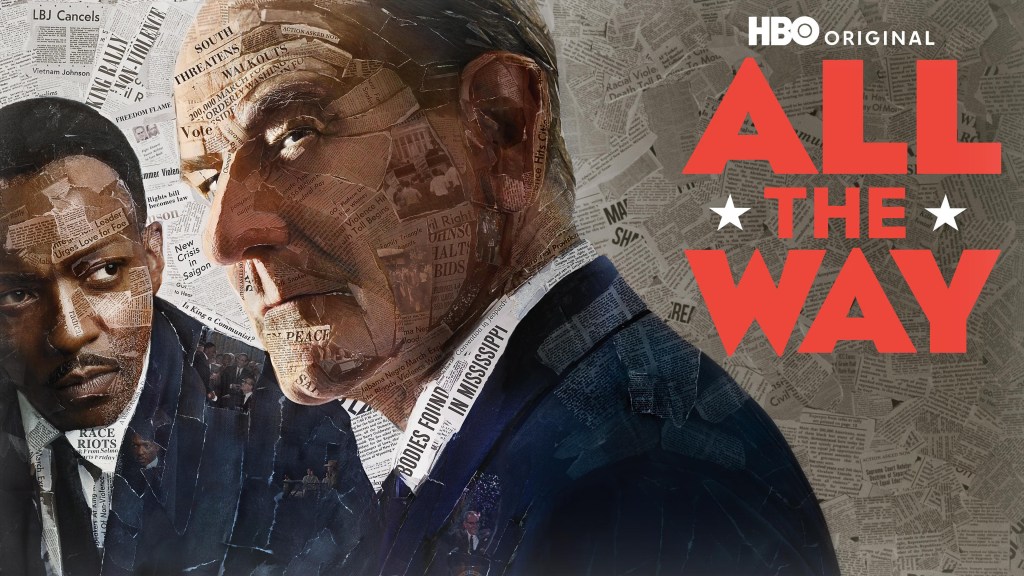
Tyler: Lyndon Baines Johnson, 36th President of the United States, took office under the specter of death. At his side as he took the oath of office stood, immortally, Jackie Kennedy, adored first lady, sudden and bloodied widow. An American chief executive had been assassinated for the first time in six decades. Johnson was not the top story.
It bears declaration, then, that LBJ shaped the 1960s far more handily than his predecessor, John F. Kennedy. Kennedy’s ascent, fueled by youth and beauty and admirable ideas, led to a tenure we can never truly assess, given all its unfulfilled promise. For all the utopian pageantry that came out of—as we still know it—Camelot, JFK’s headline accomplishment is miraculous restraint in the face of the Cuban missile crisis. Civil rights and Vietnam, well, we’ll never know. Kennedy and that uncertainty cast a long shadow.
We’ve learned a lot, then, about Kennedy successor Johnson in the fifty-plus years since LBJ’s passing. He ranks among the most conflicted, controversial Presidents of the country’s history. The man hammered away centuries of institutional racism; he entangled the American military in a ceaseless war in Vietnam. He has salvation on his hands, and blood. And, if the work we’re about to discuss is to be believed—or, rather, if the Johnson it portrays so inimitably can be trusted—all Lyndon wanted was a little love. Just a little.
All The Way, Jerry. Let’s talk.
Jerry: Absolutely – speaking from a historical standpoint, Lyndon Johnson is one of the most fascinating presidents to study, and I think this film helps to highlight some of the reasons for that. LBJ was a larger than life figure in his time, and Bryan Cranston’s portrayal of him leaps off the screen and reflects the energy Johnson brought to everything he did. Johnson’s personality, though, could make him a tough person to love.
Tyler: Watching Cranston portray Johnson in those deeply personal moments of internalized rage, all that self-doubt, makes for real curiosity. Was LBJ prone to these fits of despair? He’d hardly be the first such president, but he’s certainly one whose towering presence in person and in history makes the depiction provocative.
Jerry: Oh, that was a quite accurate portrayal. You get the sense in studying him that Lyndon Johnson felt the whole gamut of emotions very deeply. The problem, as it’s portrayed in the film, is that sometimes it’s hard to get to what is the real Johnson and what is done with an aim in mind. Lyndon could be quite manipulative and was always thinking of how he was coming across to others.
Even some of his crassness was likely an act to establish dominance. LBJ was famous for his “Johnson treatment” of physically intimidating others, but there’s also the scene where he was talking to Humphrey while on the toilet with no intention of showing any decorum or modesty. It threw people off, and he could use that. He had no shame in that regard.
Tyler: Was it not on your estimable podcast that a tale was told of Johnson nigh-assaulting the Canadian prime minister at Camp David?
Jerry: It was – oh man, the account of that told by folks who weren’t even in the room while LBJ was laying into Prime Minister Lester Pearson in April 1965 was uncomfortable.
Tyler: That blows my mind.
The President of the United States smashed a foreign leader up against a wall! And we’re supposed to just roll with that knowledge! Which, of course, we do, because that President pushed the Civil Rights and Voting Rights Acts into law. I’m not even being completely ironic there. Do we forgive such personal failings in the name of a vastly grander good?
Jerry: He was such a complicated figure – for someone who could show such disrespect and even contempt to others – foreign leaders, fellow politicians, his eventual vice president – you also get a sense of Johnson’s reverence for the presidency and the call to serving the people. In the movie, where Johnson comes into the Oval Office for the first time after assuming office, you get a sense of the weight of everything, the magnitude of it, on him.
There’s another scene later on when Johnson says, “If a president can’t do what he knows is right, then what is a presidency for?” He felt that he had to go for things hard and bring that big energy. That said, the ends don’t always justify the means, and though we don’t get to see it through to the historical end of his presidency, you get a sense of Johnson losing track of the true focus and his baser instincts growing stronger, as the pressure amped up, as the movie goes on.
Tyler: Poor Hubert Humphrey, that eventual VP. Johnson lacerates and abuses him. In Humphrey’s absence, LBJ notes a crippling truth: Hubert is too “nice” to grasp for that absolute power.
Jerry: And that is very historically accurate. As bad as some presidents treated their VPs over the years, Hubert Humphrey goes down as one of the most emotionally and psychologically abused in history. I honestly had to look twice to confirm that he was being portrayed by Bradley Whitford of West Wing fame in the movie.
Tyler: Right? It occurred to me after some time that it might be Whitford under the cap, but my initial identification of the performer was character actor David Paymer.
Whitford brings that hint of an Aaron Sorkin vibe to the proceedings. Just as, showing up where I did not expect him, Frank Langella brings a bizarre, intended or otherwise nod to Dave.
Frank Langella, who is always so stately and so old-school that I want to forgive him the creepshow transgressions that got him canned from Netflix’s adaptation of The Fall Of The House Of Usher. Apparently Frank didn’t take to the use of an intimacy coordinator. Amongst other ugly transgressions.
Jerry: He has that aura about him of being from another time, which may also explain his real life scandal – too much from a time that should have never been to begin with. Certainly, his portrayal of Richard “Uncle Dick” Russell in the movie was of someone who had that smooth charm while being a clever operator who had his way behind the scenes but who was also fighting a losing battle to turn back the clock while the world around him was moving on.
Tyler: I love the phone exchange concluding with Russell telling Johnson that Johnson is behaving like a spoiled child. Take a tranquilizer, Uncle Dick tells the President of the United States, and go to bed. Langella nails that delivery—just the right air of self-assured arrogance cut with lived-in wisdom.
Why are we talking about Frank Langella? This is Bryan Cranston’s movie, with a healthy dose of Anthony Mackie, as well. I didn’t expect Dr. Martin Luther King, Jr. to play such a considerable role in All The Way; I knew going in that the film is a theatrical adaptation featuring a showstopping role for Cranston, but Mackie’s steady hand is felt throughout.
Jerry: Absolutely! I felt Mackie could have played a larger role, but the fact that every time he was on screen, you could feel his presence reflects the talent that he brought to the role. I loved the juxtaposition of the pressure that King was feeling within the civil rights movement with the pressure that LBJ was feeling from conservative elements of the Democratic Party and Washington power brokers.
Tyler: The parallel works. Politics is war, LBJ asserts as All The Way concludes. Permitting that analogy, LBJ and MLK were both remarkable generals.
Jerry: The fact that they were able to achieve what they achieved respectively with all of the forces arrayed against both of them is astounding and speaks to why they loom large in the history of the era.
Tyler: Now, having acknowledged the gravity of the history, and the talents of the cast, how do we feel about All The Way overall? I think we’ve got a very effective adaptation of a terrific play, but as cinema I’m not quite sure. I love a good steady workmanlike approach to material, but something about director Jay Roach’s approach here felt uninventive. I’m sure he was working within a reasonable budget, and he doesn’t get in the way of the material. But there’s not much cinematic whimsy to be had. Back when Frost/Nixon was released in theaters, I lamented much the same about Ron Howard’s decisions, or lack thereof—where the film could’ve been improved by, say, shooting the Frost/Nixon dialogues on era-appropriate video, Howard drew no contrast between reality and televised drama. Here with All The Way, I feel a similar absence in worthwhile style. It’s staid. It’s a little boring.
Jerry: While I am a fan of more dialogue-driven movies with a little slower of a pace, I do have to wonder if this movie could have been taken to another level. It does feel in the end like you’re left wanting more. Whether through the cinematography or adding some elements to the plot that were just alluded to or got brief mentions, it doesn’t feel like All The Way went as far as it could have.
Personally, I think we needed more scenes with the Amphicar.
Tyler: That was something out of a Roger Moore Bond movie.
Jerry: Yet surprisingly, historically accurate!
Certainly, I’d love to ride around in an Amphicar on land and water, but I’m not so certain I’d want LBJ to be behind the wheel, even when he was sober.
Tyler: See, I thought of another HBO political docudrama in watching All The Way, that being the late Curtis Hanson’s crackerjack 2011 Too Big To Fail. That one is cast to the nines, William Hurt leading the way as Henry Paulson, and Hanson has a ball drawing together the many tangled narratives of the 2008 financial crisis, syncing style and substance with panache appropriate from the man who helmed L.A. Confidential and my beloved Wonder Boys. I’m not gonna dog on Jay Roach’s career, about which I know little. But, if he sought only to tell a memorable story, he richly succeeded. If he wanted to make a motion picture with a considerable legacy, on the other hand? He didn’t stick the landing.
I feel like I’m being churlish. All The Way has plenty of soul, and in the right places. It just doesn’t transcend. Given the characters and the subject matter, it really could have.
Jerry: Ooh, now I’ve got another one to add to my list in Too Big to Fail.
I agree. I would watch All the Way again when I’m feeling in the mood for something slower paced and character-driven. The acting in this film will bring me back. However, I would not put it up with the likes of Lincoln or Darkest Hour in terms of completely enveloping me in the experience. Like you said, the potential was there, but it just wasn’t fully realized.
Tyler: There’s no sweep! I want my political intrigue to be sweeping.
Jerry, your work has a zest that All The Way lacks. Tell us where to find it.
Jerry: I try my best, Tyler. In my podcast, the Presidencies of the United States, I do a deep dive into presidential history to help us better understand the historical figures and events that shaped each presidency and reshaped the office over time. Beyond just the individuals who served as chief executive, we explore all the intricacies of history to go beyond what you may have learned in school and better understand the real people behind the names and dates. You can find the 300+ episodes of the podcast at presidenciespodcast.com or on your podcast app of choice. Just search for “Presidencies.”
Tyler: Thanks, J. Politics might be war, but talking history can bring peace. And a sneaking knowledge that Canada’s PM owes our American president a good shove. Think there’s any chance Mark Carney cashes that in on 2026’s chief executive?
Jerry: I’d like to say that there’s not a chance, but given how this year has gone thus far, I don’t think anything’s off the table!
 Writers' Loom