Spoilers below.
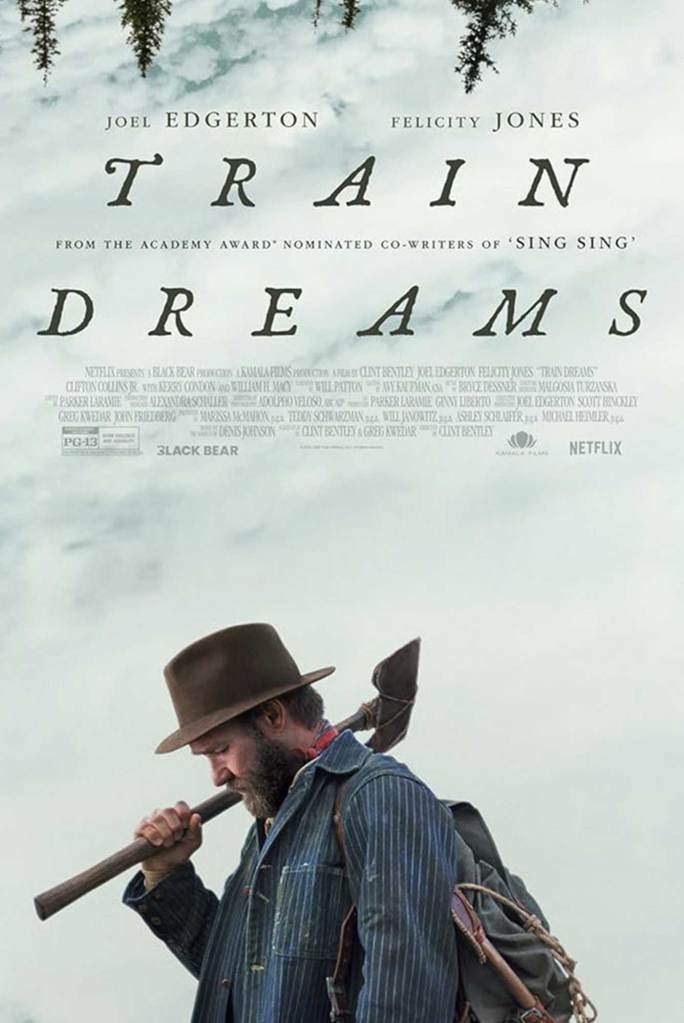
Norman: Tyler, when is the last time you were on a train? I rode a bullet train in Japan a couple of years ago, but that felt more like ground-space travel. Prior to that speedy journey, I used to ride the train from Chicago, where I was attending college, to my home in Michigan. But the truth is that I don’t ever dream of trains.
Tyler: All the way back in 2005, I rode an Amtrak from Chicago to St. Louis and back. I was in one of my life’s tougher stretches, but nonetheless had resolved to avoid drinking on the return leg of the journey. This proved less difficult than one may have predicted, as the bar car had been drained by a prior trainload of passengers, a development that proved mighty vexing to some fellow travelers I encountered during an interminable stoppage—freight trains, we all learned, had the right of way. I used the delay as an opportunity to smoke Camel Lights off the back of the rear car. Truly a romantic journey!
I still harbor dreamy notions about the mode of travel nonetheless. I think of an episode of Michael Palin’s cracking Around The World In Eighty Days travel series, wherein Palin rode a train through China. Talk about an experience! I’d love a ride like that, or even a jaunt on one of those speedy bullet trains. I’d go in for a Europass, too. There’s just a strange meandering appeal to it!
Norman: Yes, it is a romantic form of transport. Too bad it’s kind of expensive and it takes forever.
But we are here to talk about Train Dreams, a movie which, as it turns out, does not feature very many train dreams. I’m going to give a thematic spoiler away, dear readers, so you’ve been warned. This movie is about grief.
Grief has always been a difficult topic for me to encounter in movies and novels, because I have not had a lot of it in my life. My friends are still alive. My family are all healthy and living well enough. The only people I’ve really lost are my grandparents, and all of them went at a good old age, as expected. So when a movie asks me, the viewer, to feel the pain of loss, I get it but I don’t get it as well. I find myself at a loss, oddly.
Tyler: I suppose my connection to the grief in Train Dreams reflects a personal inclination to think, say, “What if I lost my partner, and in that manner?”
This movie made me ache.
Norman: Yes, it does make you think about that, but in my mid-40s, I’ve thought about that already. I get the sense that I’ll come off as callous in this discussion, but my main thought was, “Hey, my man, you need to make some friends. Or find another wife. Not asking you to forget her or your kid, but maybe after some time with grief you gotta move on, no?”
Tyler: But he does have friends! They’re itinerant, but they exist. It’s established in the early scenes that he’s a stoic without much natural rapport with other people, not outside of his everchanging outdoor workspaces. Finding Gladys gave him not only an object of romantic love and desire, but also a purpose.
Norman: Yes, but anyone who has thought about friendship knows that itinerant friends aren’t going to cut it. You need someone to talk to. He knows this, because he didn’t like being away from Gladys for his work. He knew that connection needed regular connection or it would grow frustrated. You have to know people here and now, in the flesh. Being stoic is one thing. Finding it hard to relate is also one thing. But hiding yourself out in the woods? Wallowing in your grief? I understand that his way is not unknown in the real world and is therefore worthy of exploration. But I found myself aching in a different way, wishing he would take a different approach to his life, or at least to people.
Tyler: “Wallow” is a little harsh, ain’t it? I get you on a certain level, and it’s a sad turn that Robert doesn’t seize upon the twist of fate that leads him to a second, clearly-kindred romantic interest. He’s heartbroken, though, and likely feels guilt even in thinking of a different woman romantically. Plenty of spouses feel that way about their lost partners; hell, lots of us have known such self-defeat simply in the wake of a breakup.
The era of Train Dreams is not one of grief counseling or psychological guidance. In his estimation, Robert lost Gladys and their child because he wasn’t there. No matter how foolhardy the idea, he believes he could have saved them. Letting another lover into that devastated, that guilt-burdened a heart—it wouldn’t be easy in 2026.
Norman: I’m willing to say that the problem is in me and not the movie. But I still can’t move past it. You don’t need a therapist to know that grief can’t consume you forever.
Let’s take a different tack for a moment. This movie is, for lack of a more appropriate adjective, beautiful. Every frame is lush with nature, the play of light and landscape overwhelming on its own, apart from the narrative. I was reminded, rather obviously, I suppose, of Terrence Malick. Train Dreams made me want to go back and watch Days of Heaven or The New World. It’s rare and wonderful to see a movie commit itself so throughly to the outdoors, to the sensory experience of weather and time.
Tyler: It’s gorgeous. Oh, how wonderful it must be on the big screen.
Norman: Unfortunately, I had to watch it on Netflix. Our local art house had it last fall, but it only ran for a week or two and I didn’t make it. One more decision I’ll live to regret.
It’s always shocking to me how much beautiful cinematography, seen on the scale of a theater, can save otherwise frustrating movies. Yesterday I went to see a screening of A Room with a View, that stuffy English romantic drama from 1985. It was completely predictable, wonderfully acted, and absolutely stunning to look at. Train Dreams, even on a standard issue flat screen TV, was a stunner.
Tyler: I watched it at home as well. Perhaps this year’s Oscar nominations will catapult it back into theaters. A Best Picture win would almost certainly do the trick.
We’re nearing discussion’s end, but we’d be remiss not to note the clear parallels Train Dreams draws between its period narrative and our modern era of brutalized immigrants. Robert is haunted not only by his lost family, but the specter of an Asian man he sees dragged away and thrown to his death. That man, murdered in cold blood, reappears throughout the film, in Robert’s agonized memories and dreams. The effect is chilling—the phantom never speaks, nor changes his facial expression. He’s a ghost, and for his memory there will be no resolution.
Norman: Robert is sensitive to all kinds of death and loss.
In today’s political climate, I think a lot of people forget, choose to forget, or are just plain ignorant of the fact that immigrants have been a part of America since its inception and long before. They have been a major part of the labor structure behind all the advances in technology and, in this case, transportation. Here we see that depicted in dire terms. As it was then, so it is now.
Tyler: Small wonder, then, that Robert’s dreams include trains. Their appeal, that strange alchemy of comfort and escape, must offer a glimmer of a thrill to his low soul—though, even then, the train in those dreams is often headed straight for another victim of progress.
Norman: I want to touch on one aspect of Train Dreams that I rather enjoyed. It does a phenomenal job of relaying the passage of time and the ephemeral nature of both our lives and the work we do in our lives. This is what made me ache.
Tyler: For all he loses, Robert has his work. Of course, that work doubles as destruction, a dark fact of which Robert is very aware. He’s not building, not really, except for his atypical stretch of railroad construction.
Helluva film we’ve got here, Norman.
Norman: Yeah, despite some of my more personal reactions, Train Dreams is an excellent movie. Boo hiss to Netflix for their idiotic anti-theater policies. This one deserves to be seen on a massive screen. Maybe that would have melted my cold heart a bit more!
Tyler: Beautiful cinema made for a small screen. Talk about a dark side of progress.

