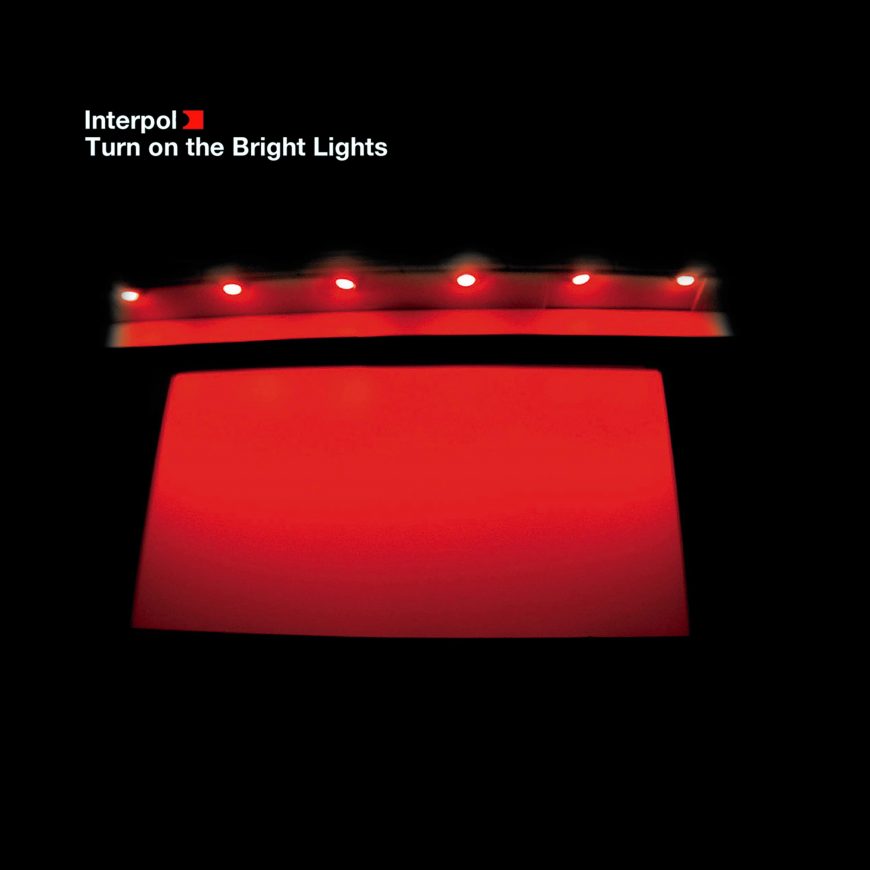
Travis: And now, without further delay, Turn on the Bright Lights by Interpol.
Tyler: Travis, I’ve known for some time that this is an album you hold pretty dear. The music dates back twenty years now, so your initial appreciation was that of a much younger man. To my ear, Turn on the Bright Lights has particular moments that call out to such a youthful time. I can see why you appreciated it even then.
Travis: Yeah it is definitely from when I liked sad music by people who live in cities, a genre I no longer appreciate as much as a grizzled old man.
Tyler: That was my next point of interest. How ya like it now?
Travis: I’m sure that nostalgia is a big part of it, and I don’t listen to it nearly as often as I used to, but I still think this is a damn good album. If not for Is This It, it would be the defining statement of the early 2000s NYC rock revival. Like the Strokes, it sounded then completely modern while hearkening back to a previous iconic musical place and era (in Interpol’s case, Britain in the post-punk late 1970s – early 1980s of Joy Division, the Smiths, The Chameleons, and many other bands who could be described with words like “distant” or “angular” vs. the Strokes’ throwback to 1970s NYC). I think Turn on the Bright Lights and Is This It are the only albums from their particular “return of rock” scene that have aged well enough to become classics when removed from their era.
Like the Strokes (I think it’s hard to talk about one band without talking about the other, since the success of the Strokes paved the way for Interpol, the Yeah Yeah Yeahs, the Rapture, and others), I also think Interpol are wrongly tagged as imitators. You can say they sound like Joy Division or the Smiths or whomever just like you could say the Strokes sounded like Television or the Velvet Underground, but I think even the most untrained listener could tell the new bands apart from the old.
Whatever the case, the hype in the case of Interpol was warranted if only for this one album, which sounds late-night perfect. The band had been together for about six years when this album came out, so they had plenty of time to hone their repertoire for an impactful first album. The production from Gareth Jones (Depeche Mode, Einsturzende Neubauten) and Peter Katis (later to produce The National among others) conjures the exact right atmosphere. The rhythm section drives the songs with intricate basslines that interlock with active drums, and the dueling guitars are simple but clinical. Listening to this shit twenty years on, it still rules. To me.
Coming to it new in 2022, how did it sound to you?
Shit, 2023!
Tyler: You daft fool. Get it together.
My very first impression of “Untitled,” the opening track, was one of those “Ooh, I want more of this” moments. That’s a hell of a chiming ringing riff, and to my mind it brings memories of room-filling rock shows. Those are good memories. “Untitled” also makes me want to see Interpol live, because it is a song built for large amps and stage lighting.
As for the album writ large, I like it, I admire it, and will listen to it in the future. Only when I’m in certain moods, though—you’re right in your assessment of this as a late-night record. As we write, after nightfall, it sounds just great. Earlier today, as I was running errands on a lunch break in a cold sun, it sounded strange and off-putting. That’s no knock on the album or the band, mind you. I’ll take a late-night LP over a daytime record most of the time.
Travis: Yeah, the only errands that should be run to this album are perhaps a late night gas station run, or in a past life, walking home with headphones in after striking out at the bar and regretting every decision you’ve ever made.
It’s definitely a nighttime album, and for me an icy wintery album as well. It conjures that feeling of being in a densely populated city with a million people close to you, yet knowing that despite the proximity of so much humanity, you’re alone.
I will say that the feelings conjured by this album are entirely musical and come from the sounds being made, not the lyrics being sung. If there is one knock I think one could legitimately make about the album, it’s that the lyrics are dumb, goofy, ponderous nonsense. I think that’s a fair critique (especially since I’m the one that just made it), but none of the lyrical clunkers take away any enjoyment from me, and I have sung “Sleep tight/Grim rite/We have 200 couches where you can sleep tonight” at the top of my lungs as part of large crowd in 2004 and 2022.
Tyler: See, the “200 couches” line is the lyric that sticks out to me more than any other, because most of these lyrics don’t stick out.
That line, to its credit, takes me back to very wayward late nights that concluded with lousy sleep on a friend’s couch. Past lives indeed.
Travis: To be clear, I love the lyrics. And I think they work in the context of their songs and how they are sung. But I’d be the first to admit that some of them are goofy as hell. “The subway, she is a porno” is utter nonsense. “Her stories are boring and stuff/She’s always calling my bluff” would get called out by a sixth grade english teacher as being lazy.
Tyler: “And stuff” is pretty rough. “The subway, she is a porno” sounds like young-artist’s profundity. I know I keep describing this album in terms of youth. It just fits that profile.
Hell of a delivery of the album’s title in “NYC.” Bar none. That’s a moment I want to experience in concert.
Travis: Hell yeah. I think we’ve covered the album as a whole, its mood and what it conjures. Let’s dig into some individual tracks. “NYC” is a highlight, and you’re right, the “turn on the bright lights” portion of that one is epic.
Like “Untitled,” which I think is the other really good “slow” song on the album, “NYC” moves slowly but still manages to be driving, never boring.
Tracks 2-4 were all singles, and still feature prominently in the live show twenty years later.
Something that gets said about a lot of bands is that they only write one song over and over again, but it’s a hell of a song. I’ve heard this about the Ramones, AC/DC, Motorhead, many others. I think Interpol has three songs, which appear in different incarnations. The slow burning almost ballad (“Untitled,” “NYC,” “The New”), the post-punk-inflected rock song (“Obstacle 1,” “PDA,” “Obstacle 2,” “Roland”), and “other,” where I’d put “Say Hello to the Angels” and “Stella Was a Diver and She Was Always Down,” since they bring in elements that don’t really fit either template.
My favorite track has changed over time. I think at this point it’s the sucker cut, “PDA,” again. Nothing wrong with liking the biggest hit the most—there’s usually a reason a hit is a hit. But for a long time it was “Say Hello to the Angels.” It’s longer than most songs on the album, has a bit more of an epic feel, and with the bass-heavy breakdown at the end, goes HARDER than any of their contemporaries ever really dared to, moving from post-punk to post-hardcore.
Even though I like the album as a whole, I think tracks 1-5 and 8 are clearly higher quality than the rest. The others being “lesser” versions of one of those three “Interpol templates”. Anything else stand out to you?
Tyler: Much of the album blends into a larger piece, to my ear. That’s not to criticize. More to say, given the lack of hooks and refrains, as well as the abstract song titles, the album forms a greater whole that sometimes subsumes the songs as individual pieces. The only moment the mood breaks is the intro to “Stella,” where one of the band members introduces the song.
Travis: Word. I have lived with this one about twenty years longer than you have.
Tyler: I do want to take another moment to highlight “NYC,” as I feel it captures a romantic image of New York that is very seductive. As a Midwesterner with past dreams of moving to that city, I’m reminded of those earlier yearnings for those grand skylines and everything contained within.
That’s a credit to the band. As you describe, this is a decidedly New York album. That they can lay down a track—the ostensible title track of their debut—that nails the city in one go is pretty fucking impressive.
Travis: All I can say to that is well said.
Tyler: Appreciate you. It’s a great album.
Now, aren’t Interpol looked upon as kind of a one-album wonder? They’ve continued to produce work. Is any of it worth a listen?
Travis: I think they’re generally considered a two-album wonder, but I’d call them a one-album-plus-a-couple-songs wonder. The second album, the atmosphere is all off. Where the production of Turn on the Bright Lights is icy and clinical, the guitars playing off of each other in counterpoint, Antics feels sloppy and generic. It’s like they took six years crafting the debut and six minutes on the followup. Still, check out the songs “Evil,” “Slow Hands,” and “C’mere,” which are fun mid-oughts indie rock songs and I’d probably rate them even higher if they were by a different band.
According to Allmusic, they have released 7 studio albums. I tried very hard to like the second and failed, listened to the third MAYBE twice and found it kind of embarrassing. Bassist Carlos Dengler must have felt the same, as he quit the band after that. From a number of things I’ve read, he was the real musical driver behind the band–could play any instrument, handled a lot of the writing, knew a lot about arranging. I never felt it necessary to listen to any album he didn’t have anything to do with.
That said, I saw them in their new incarnation with replacement bassist and additional keyboard player in September of 2022 and it was a fun time. They’ve settled into the role of a legacy act, playing a couple new songs but closing out the set with a run of favorites from the first two albums, but they’re good in that role. Good stage presence, good sound, good lighting and atmosphere, well-paced set. Though I think their tourmates, Spoon, are a more musically admirable act over the span of their career, Interpol was much better at constructing a live set based around their best material.
Tyler: Is the additional keyboard player Michael McDonald?
Travis: I’d kinda love to hear Michael McDonald sing “Stelllllllaaaaaa….Stel-a-aaaaaa”
As far as other recommendations for someone who really likes Turn on the Bright Lights, I’d look to other NYC artists from the years following Interpol’s peak (their Meet Me in the Bathroom-chronicled contemporaries beyond the Strokes were pretty weak sauce). I think LCD Soundsystem’s Sound of Silver conjures a lot of that same atmosphere and is immaculately crafted–a sad music by people from cities classic. In years following, The National’s Alligator and Boxer scratched the same itch for me. And I’d be neglectful not to mention CoMO/St. Louis-to-NYC transplants White Rabbits, whose first album Fort Nightly is kinda like if Interpol really liked the Specials and Fun Boy Three instead of Joy Division and the Chameleons. Also, the Walkmen have one great song that I think fits here, called “The Rat.”
Tyler: I’d rather like an Interpol run-through of “Takin’ It To The Streets.”
Travis: Interpol/Michael McDonald Split 7″
Tyler: And here we thought we had jams when we reviewed George Michael.
Travis: George Michael singing “NYC”
Tyler: Mic drop.


Loved this discussion of Interpol. This is one of my favorite albums of the new millennium (or past 23 years-ish). A stone cold classic.
The only thing I would add is that this is the kind of music that seems to work better on record than live. Travis’s reference to dueling guitars that are simple but clinical is exactly on point. I saw Interpol at the Pageant in 2004 on their tour for ANTICS. It was a very clinical performance, especially in every song they did from TURN ON THE BRIGHT LIGHTS. Not that this is a bad thing…. I appreciate musical professionalism and the ability to do a note-perfect performance of songs from TURN ON THE BRIGHT LIGHTS is not to be taken for granted. Still, at the time, I felt like I could have driven around the Pageant for an hour blasting the CD on my car stereo and the overall experience would be little different.
I might add that Interpol was not quite sui generis. Just a few years after BRIGHT LIGHTS, a British band called The Editors released THE BACK ROOM, an album that plums the same formula and draws from the same influences (Joy Division, Echo and the Bunnymen, the Smiths). THE BACK ROOM is not quite as good as BRIGHT LIGHTS. But for me, it sounds like the second or third album Interpol should have recorded instead of the ones they did. Here’s a sample: https://www.youtube.com/watch?v=NXisq5jOrPk.
LikeLike