Spoilers below.
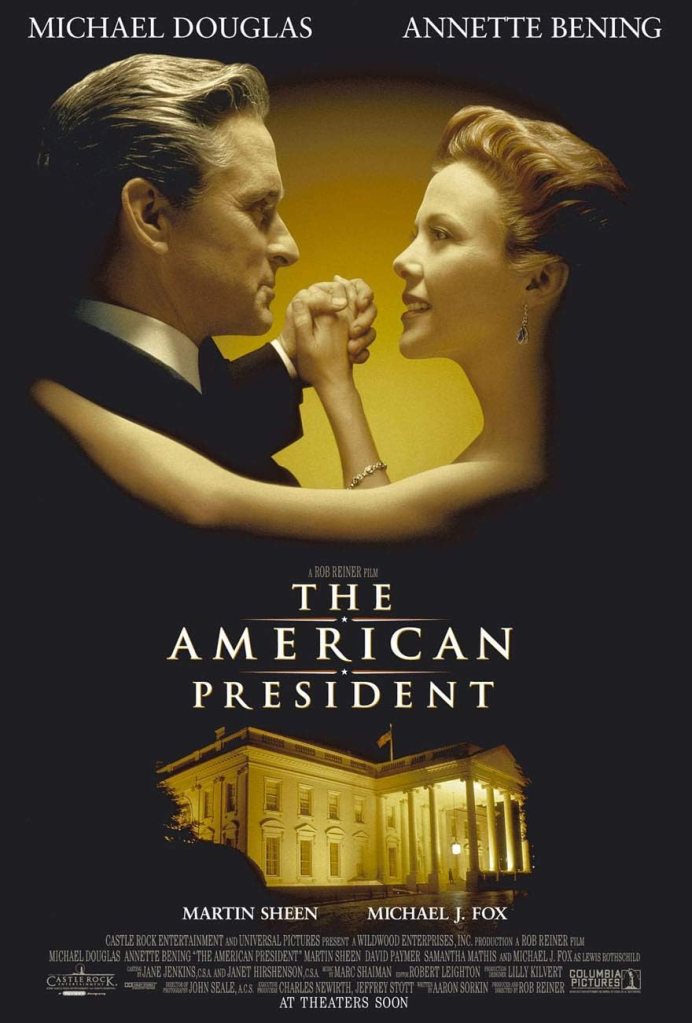
Tyler: Jerry, in the weeks leading up to this conversation, I mentioned to Loom’s history buff buddy what film you and I are discussing. The buddy, with no small measure of disdain, noted that the movie is a favorite of his mother.
Here we are then, friend, talking a big cinematic slice of neo-liberal 1990s American political optimism. I’m pretty sure my friend’s mom isn’t even a Democrat, and yet she’s pulled in by the picture’s Frank Capra style. We’ll get to whether the work meets that pedigree. It’s time to talk The American President.
Jerry: Let’s do it! As you know, I’m always up for talking all things cinematically presidential, but I have to start out confessing that this one’s a personal favorite of mine as well. Yes, I’m a fan of early Hollywood classics, and yes, I always got along with my friends’ moms when I was growing up. It all tracks.
Tyler: One thing I wanna highlight right outta the gate is the relative risk of casting 1995 Michael Douglas as the hero, President Andrew Shepherd. Douglas in those days was coming off of some real real adult material, specifically Basic Instinct and Disclosure.
Jerry: It was an interesting choice at the time and I think was responsible for expanding his repertoire moving forward. I mean, one of the reasons that I was confident of his ability to pull off his role as Benjamin Franklin in the 2024 miniseries was because he was such a good fit for Andy Shepherd – confident and poised yet with a heartwarming (and for certain segments of the population, attractive) glint of vulnerability.
Tyler: He also took on a political role as America’s “drug czar“ in Traffic.
Personally, I love Douglas eternally for his role in the personal favorite Wonder Boys.
Jerry: I was looking at his filmography and am realizing how much I need to catch up on. The Marvel stuff, I’ve got, but seriously, he played Liberace?
Tyler: Directed by Steven Soderbergh. I’ve wanted to see that since it aired.
Matt Damon as his partner!
Jerry: Ok, ok, I was already sold – Pride Month Loom movie?
Tyler: Count me in.
Jerry: But, getting back to The American President – Annette Bening – this is the first time I remember seeing her in a movie, and her performance as Sydney Ellen Wade has stuck with me ever since.
Tyler: As you note of Douglas, she brings just enough vulnerability, smitten as her character comes to be. Crucially, we get to see Sydney in action as a reknowned lobbyist, and she is ferocious.
Jerry: I know that she had a couple of big roles before this one – Bugsy alongside Warren Beatty and the Richard III adaptation as Queen Elizabeth (not that Queen Elizabeth) – but this role I think put her on the map. Her character leaps off the screen, and for me, throughout the movie, I was just waiting for the next scene with Sydney to come on. Not that they didn’t have a wealth of talent on this film, but she just brought something special to it.
Tyler: I do mean it seriously when saying that Bening has a considerably well-known status as the woman who tamed Warren Beatty.
And I don’t mean to bring salacious gossip into the scene here. But, this is Hollywood, baby.
Jerry: If anyone could, it is Annette Bening. And, of course, even greater cinematic heights awaited her with American Beauty.
Tyler: Oh boy. We might actually disagree on one if we revisit American Beauty.
Not that she’s bad in it, or, really, any of the actors. But the movie as a whole…well. I’ll reserve that for another day.
Jerry: Hot take! I look forward to that conversation.
Tyler: You’re on. For now, though, I think we’re gonna keep aligning on American President. If you’re a romantic liberal believer in this country, it’s catnip. I mean, with Aaron Sorkin at the keyboard, it’s entirely a proto-West Wing.
Jerry: Absolutely – as a West Wing fan, this film (which preceded and inspired that show) reads as a who’s who of folks who would end up in the Bartlet White House (albeit with different names and slightly different characters).
Martin Sheen of course, but also Anna Devere Smith and Joshua Malina. There was even a reference to a Governor Stackhouse, and in The West Wing, there was a Senator named Stackhouse who was even referenced in an episode title – “The Stackhouse Filibuster”.
Tyler: That crafty Sorkin!
I’ve only watched a couple of episodes of West Wing—I caught those while in college, as the George W. Bush administration hung like a black cloud for those romantic liberal believers, so I don’t know why I didn’t catch on as a regular viewer. I do know that now, a couple decades on in 2026, I’m not interested in making up for lost time. The American President times out perfectly, clocking in tidily under two hours. In these days of new-American fascism, my faith in the Great Experiment shattered, I can only take so much memory of times when history’s great dreams felt tangible, within reach. This film was released two years into the first Clinton administration, when people associated the President more with “Don’t Stop” than abuse of Monica Lewinsky. Even moderates were on board with that ’90s hope, this idea that Things Were Going To Get Better.
The American President, then, with its good man and good woman at the center, surrounded by good people, it found a sweet spot.
Jerry: That is one thing that is very striking about watching this film now. I first watched it a year or so after it came out, which was in the midst of the Clinton administration when the societal vibe in the United States was generally more feel-good, things are on an upward swing. Now, while it tugs at my heartstrings, it is in part because I know that is an era long since passed.
This movie, and indeed, The West Wing, could not be made today. It would be seen as too unrealistic.
And, indeed, even possibly dangerously overoptimistic.
Tyler: This movie’s bad guys win in reality’s long run.
Jerry: Speaking from a historical lens, part of my work with Presidencies is to remind folks that the last volume of history is not written yet and that, while things may trend one way for a bit, the only constant of history is change.
But yes, the type of politics that is practiced by the antagonists in this film – mudslinging personal attacks – has been on the ascendency and has become status quo in the present day versus the lofty idealistic statesmanship practiced by the presidential protagonist.
Tyler: The dispersal of that mudslinging by major media outlets, too, is on full display.
It’s almost chilling if you step back. Andrew and Sydney finally get to spend the night together, and they’re met before dawn with a sea of reporters and cameras surrounding the White House.
Jerry: One thing this movie is spot on about and something that is relatable especially in the present day is the fishbowl aspect of the White House. Back in the day (19th going into the mid-20th century), while there was a ton of activity around the White House, there was at least a modicum of respect for the private life of the First Family. Not anymore. Martin Sheen’s character, Chief of Staff AJ MacInerney, references this – Wilson was able to date and FDR’s paralysis were not talked about in the press because they didn’t have to be president on television.
Any privacy the First Family has nowadays is hard fought for and tenuous at best, because there’s usually someone willing to tell all in order to gain fame and/or fortune.
For the viewer of this film, that is one thing that we’re made to empathize with – these are two consenting adults. Why should their burgeoning relationship be a matter of public scrutiny?
I mean, honestly, the greater travesty was that blank white wall in the walk between the residence and the Oval Office.
Tyler: Gold leaf in every corner! Gilded Age II!
I kid, I kid, I weep.
Jerry: Thank heavens there’s a Presidential Walk of Fame now. I mean, it just looks so weak to be so barren. People have been laughing at us for decades about that.
In American President, at the State Dinner in the East Room, they were all crowded in together. President Andy and Sydney hardly had room to dance. They were calling for a proper ballroom even then, honest.
And they’ll all be speaking American, as one should.
Tyler: Man, the guests in that new ballroom are gonna be grinding and feeling each other up all over the marble or platinum or adamantium floor. It’s gonna be a high school mixer featuring cretins and despots.
But I digress.
American President‘s State Dinner scene is especially delightful. From Sydney’s easy French banter to the lovely lovely waltz. I find my generally-unfriendly mind on occasion returning to Andrew’s irresistible response to an awed Sydney.
Sydney: Two hundred pairs of eyes are focused on you with two questions on their minds: Who’s this girl, and why is the President dancing with her?
Andrew: Well, first of all, the two hundred pairs of eyes aren’t focused on me. They’re focused on you. And the answers are “Sydney Ellen Wade,” and “Because she said yes.”
Jerry: I’ll be honest, I appreciate the suave romance of this film now much more than I did when I first watched it when it came out, and kudos to Annette Bening and Michael Douglas for the on-air chemistry in their performances.
The flirtatious back and forth and genuine admiration and pleasant surprises that weave through the film are a masterclass in acting with an on-air partner.
Tyler: They’re both so damn winsome. It’s adorable. The film has darkly adult turns—Richard Dreyfuss’s loathsome presidential candidate accuses Sydney of tracking in sexual favors, for God’s sake—but the proceedings overall manage to warm the heart.
Jerry: And I’m curious to know, as you brought this up earlier, in your estimation, does this correlate with a Capra-esque Mr. Smith Goes to Washington story?
Tyler: Oh, a hundred thousand percent. Vital, really, is the scene in the war room wherein, after approving a strike that will kill at least three innocent people, Andrew grimly describes the deaths on a personal level, describing his military go-ahead as the “least Presidential thing I do.”
He’s a good man. He’s impeccable. No politician is that upstanding. Nobody’s Mr. Jefferson Smith, and nobody’s President Andrew Shepherd. They’re fantasy. Frank Capra laid the groundwork.
Fantasy, mind you, that has a fascinating understanding of the process. It’s just realistic enough to be, yep, overoptimistic.
Jerry: I’d say that the one slight deviation from Capra and, as we know it post-West Wing, the Sorkin treatment is the parallel romantic plot line going on here. While there are elements of that in Mr. Smith and West Wing, ultimately, the political idealism is the focus with the romance as a side story whereas with The American President, I’d say the romance between Andy and Sydney is just as important as the President’s political battles.
Tyler: And that’s only natural. Infatuation, especially if it blossoms into love, plays a functioning role in one’s everyday judgement.
Jerry: And that love can be an inspiration, driving us to going beyond what we were to become something better, something more. Especially now, embracing inspiration and the transformational power of love is much needed. While comparatively dated (did you see that old-school computer?), I think this film gets us in that space, and you’re left feeling hope that maybe, just maybe, there’s room for grace, respect, and love in this old cynical world of ours.
Tyler: I’ll hope vicariously through you, my dear pal.
Jerry, we’ve talked today about a fictional American presidency. Tell us where we can find your exquisite work breaking down the real thing.
Jerry: Thank you so much, Tyler! If you’ve ever wondered how U.S. presidents—and the teams around them—have shaped the nation’s history and influenced the world we live in today, the Presidencies of the United States is here for you. In my podcast, I dive deep into American presidential history from 1789 to the present, exploring the people, decisions, and pivotal moments that defined each administration while at the same time uncovering the lesser-known narratives, overlooked figures, and surprising connections that rarely appear in textbooks. The website is presidenciespodcast.com, and I can be found on all major podcasting and social media platforms along with YouTube.
As always, I greatly enjoyed the conversation and hope that this helps to inspire folks to engage with more fictional and non-fictional history.
It’s important to learn from the past, both for inspiration and for what not to do, and even the fiction can help to develop our empathy in understanding that history wasn’t just names and dates but the story of real people and give us the freedom to imagine what could be.
Tyler: Thanks, Jerry. I’m sure I’m not the only one who needs to hear that.
 Writers' Loom