Spoilers below.
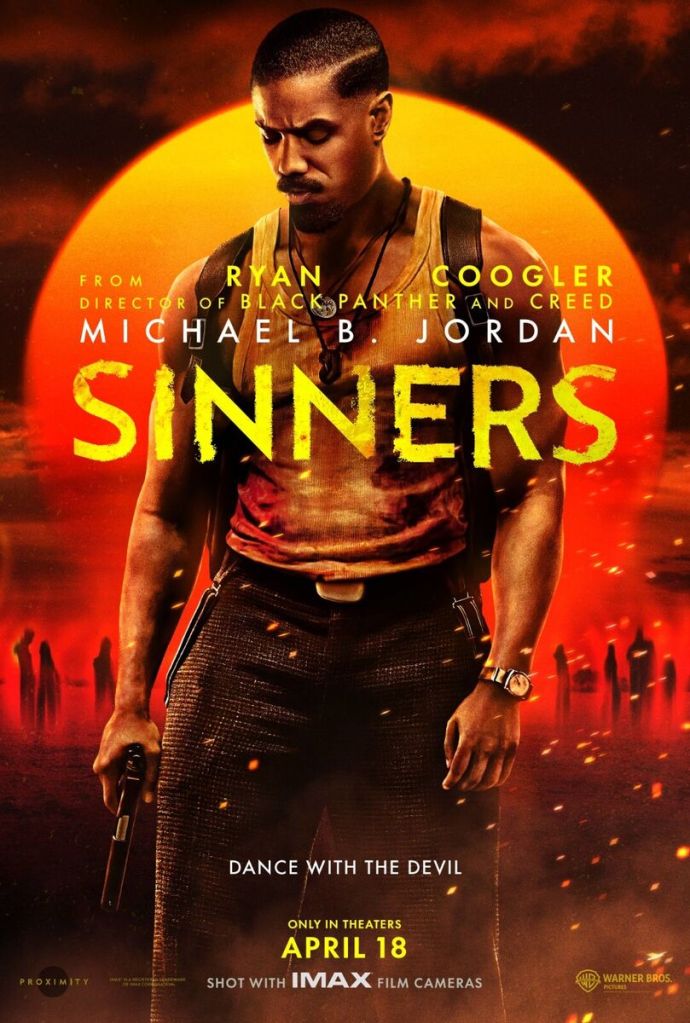
Jerry: As the thunderclap of a Southern summer afternoon pop-up storm rolls on my end, it seems like the perfect time to venture into a discussion of a movie rooted in the deep South from which I was born. Heaven help you, Tyler, but I and this movie are going to take you (and our readers) on a journey into the dirty South.
Tyler: A sludgily humid Midwestern heat has settled over my town. No rain, just ugly bulging air that greets you like a slammed door. Your hovering storm sounds like a late-June revival. So let’s get down to a movie that functions as a holy service, blood and fangs and all.
The aim with our chats has been to have critical fun looking at movies oriented around or to do with the presidency of the United States. We have done so. It has been grand.
This time, though, we’re looking at America through a different lens. No presidents. On display instead is our country’s history of murderous racism, as well as its contrary absorption of non-white culture. We love looking at the leadership, Jerry, and we will continue to do so. Today, however, it’s time to look at what that leadership, or lack thereof, wrought upon all its people. Not just whites.
I can’t say I was expecting so much from Sinners, a film about which I’d heard precious little—Hollywood having so much faith in African-American content and all that—but a dear friend advised me that, oh yes, is it worth seeing. He was not wrong.
Jerry: Absolutely. This movie is one that gets to so many things including the heart of the Mississippi delta and the incomprehensibly relevant reality in this day – 2025 as of this discussion – for folks in the delta.
Tyler: 2025. Nearly a hundred years after the setting of this ferocious movie. Still fighting the same battles for equality and humanity. The forces of hatred and evil are piping up, too.
Jerry: I think this movie by its nature and some of the elements of it invites us to think of a generational fight against evil. There’s never a “we’re done” point in the battle, and that’s something important in the conception of democracy – it involves all citizens. As this movie shows, however, that is beautiful, and it is also messy.
Tyler: As Sinners concludes, one of our protagonists—Sammie, known in youth as Preacher Boy—a Black man long in life and full of the blues, puts it perfectly when offered immortality. “I’ve seen enough of this place.”
Jerry: That’s a great takeaway, and for the sake of our readers who may not have context yet, let’s dive into this movie because there is so much to unpack.
Tyler: Hell, where to begin? I think one of the most prominent, threatening themes in the film is cultural appropriation. This was highlighted by my recommending friend, and it sure is a major piece of what Sinners declares. As a white vampire says to a Black man: “I want your song.”
Sure enough, caucasian theft of African-American music led us to, say, Eric Clapton, an overrated guitarist whose stage-boasted hatred of non-whites undercuts the slim merits of his endless catalog. You wanna talk about theft of soul.
Jerry: That appropriation began long before Eric Clapton, and it’s a history that my better half could speak to with more expertise, but I think of Elvis Presley and the Rolling Stones. Even before them, there are examples of it.
And race is intentionally one of the big factors in this movie.
Tyler: I’d venture further and say race is the motivating factor behind Sinners. Any major Hollywood motion picture boasting a largely-Black cast, helmed by a renowned Black director, stands as rather a statement of purpose. A lot of us white people chuckle ironically when confronted with a broad caricature like Tyler Perry’s Madea, but those movies were unbridled successes pushing the righteous narrative that there is a wide audience—a paying audience—of Black cinemagoers who want to see movies representing them, their lives, their senses of humor, all the elements of existence that nigh-exclusively go overlooked in the film industry. When racism is addressed by the studios, too, it’s often in pat white-male half-guilty platitudes. Sinners is a stirring, heartbreaking piece of work, maybe a masterpiece, but there is rage in its core. For good reason.
Jerry: Definitely for good reason and as this movie makes clear – let’s get into the nitty gritty, as there is so much to unpack there beyond just the bang up job that they do in conveying the oppressive nature of the Mississippi delta which continues to this date. Let’s talk about the twins.
Tyler: Give Michael B. Jordan the Oscar. Today.
Jerry: Amen, brother!
Tyler: He is wonderful. I did not know going in that he was playing two roles, and it sunk in that, yes, one single actor is playing both Smoke and Stack.
Jerry: And the fact that he portrayed them in a way that you truly felt they were two separate characters.
Man.
Tyler: Right?
Y’know when something struck me? Early, as Smoke and Stack—Jordan and Jordan (!)—part ways, each to run some weighty errands, they embrace and tell each other “Love you.” Right there, that touch.
Jerry: This was a movie that was all about the heart (which, given the vampire twist, adds a whole other dimension).
Tyler: Another moment that even now, weeks after screening Sinners, leaves me affected: Annie nursing the child she shared, and lost, with Smoke. The three of them have left this world, it’s true. But they’re together, a family. I shake my head and tip my cap.
Stack’s tortured bond with Mary, too, his desperation to keep her safe, is not the stuff of skin-deep art.
Jerry: Belonging and not belonging is a central arc in this movie. It comes up in the socio/economic/cultural sense but also in the vampire/living sense. Who’s in, who’s out, and where does it become problematic?
Tyler: The vampires gotta be invited in.
Jerry: Even though they were supposedly freeing everyone.
That in itself is a conversation.
Tyler: It’s true. At this point, I don’t think either of us consider it hyperbole to declare Sinners one of the more thoughtful, thought-provoking major releases in recent memory. The twins, our other heroes, have been rejected by the high life in Chicago, and even in their hometown are plagued by parasites and killers. They fought in the Great War for America; in America, then, there is no place for them. They’re not invited.
Jerry: The whole idea of being invited given the context of the time – we see this with the Cornbread scene. His trying to frame being invited as being polite, and then it being brought back to him that he had been interacting in that world the entire day without a formal invitation. That speaks so much to the racial spaces and interactions of the time (and today).
In terms of the structure of the film, did it seem to you like it did to me that there were two distinct acts to it? If so, where did it seem to shift?
Tyler: I struggle to find a fulcrum. The moment I think of as a major turning point, a climax leading to a finale, is Grace screaming at top volume to invite the vampires in.
Jerry: That is definitely a turning point, but I’d like to ask you about the point where Preacher Boy is performing at the juke joint – the transcendent experience. What are your thoughts on that scene?
Tyler: That moment speaks to the beauty of music, the wonders of ethnic culture, the promise of America. I love it!
Jerry: To me, that’s the heart of the movie, and you spoke about the other transcendent moment with Smoke, Annie, and their child – this movie delivers a message that we are all actors in things that are much larger than us and that, even given that reality, our decisions carry great weight and consequences.
Tyler: The old canard. Destiny or divinity running up against free will.
I say that not to be glib—Sinners opens in a church, and Annie is a Hoodoo believer.
Jerry: I think this movie does a great job of presenting it as a “yes/and” proposition. There’s definitely some fate coming into play, bringing actors together, and what they do in response matters.
That’s the reason it is such a pivotal moment in time, as exemplified by the survivors of it and their interaction at the end of the movie.
Tyler: What a tremendous finale. I hate spoiling things, even the notion of a “post-credit sequence,” as it can leave a viewer waiting instead of experiencing. When raving about Sinners to coworkers, though, I made sure to throw in “Don’t stop watching when the credits start.” The scene in the club, oh, my, Jerry, it is remarkable. Truly great.
Jerry: But let’s backtrack a little bit, as we don’t want to miss some other key moments (and there are many in this movie). Let’s talk about the original vampire and how he ended up running into the Klan household while being chased by members of the Choctaw Nation, portrayed by actual members of the Choctaw Nation (and speaking the actual Choctaw language). Being from the South, that was a big moment for me.
Tyler: The inclusion of Native Americans adds a layer of observation to the narrative. They certainly didn’t invite European whites in. But, here they are.
Jerry: There are layers upon layers upon layers in this film, and the complexity of it is reflective of the complexity of reality. These layers in a historical fiction are the same as what exists in the present day.
The implications may be a little different, but as we’ve seen, they may not be quite so much as we may have hoped.
Even in that, though, Sinners provides us with a shining light of hope.
Tyler: A few lights, I reckon. Music. Camaraderie. Laughter. Good sex. That’s something we haven’t yet addressed—this is a film unafraid of sensuality, and that is something in a world of whites who fear Black carnality.
It’s played for fun, even, as one of the brothers advises Preacher Boy on how to go down on a woman, in real matter-of-fact fashion.
Jerry: And even that speaks to the revolutionary approach of this movie – in numerous points of the movie, they talk about or express a woman’s sensual pleasure. We wouldn’t think in 2025 that it would still be such an unusual concept, but yes, women can enjoy sensual experiences and can in fact be the focus of them.
Tyler: I don’t know what the hell you’re talking about, Jerry. Women are incubators for whom coitus is nothing more than conception! More babies, more babies!
But I digress.
Jerry: As a gay man, I sadly have nothing to offer to female sensual pleasures, but cheers to all who feel that all participants in of-age consensual sexual experiences should experience pleasure. Again, wouldn’t think that we’d need to be saying this in 2025, but actually be attentive to your partner’s needs, folks. It’s not just about you.
Tyler: I think I just jolted the neighbors with a hearty guffaw.
Jerry: Sorry, Tyler’s neighbors!
So another point of connectiveness I’d like to bring up – the garlic scene.
And here’s where we get to I think there are two acts of this movie – the first is focused on making the juke joint and all of the relationships involved with that and Preacher Boy’s role as a musician who can pierce the time-space continuum while the other focuses more on the vampires.
This scene is firmly in the second part where they’re still trying to figure out who is and who isn’t. And there’s a tension. They’re all supposed to eat a clove of garlic to prove that they’re not a vampire. I don’t know about you, but I’d be like Pearline and gag at the thought of eating a raw clove of garlic though I do love garlic.
Tyler: Never snuck a tiny taste when slicing up a clove?
It’s not the most pleasant.
Jerry: Yeah, no, but she does it and they all do. Then they realize that someone they had cast out may have been cast out in haste.
But when they try to bring him back in, they’re too late and they get to literally witness his unfortunate demise.
That scene spoke to me as someone who has made a conscious effort of not having a litmus test for who was “in” my inner circle. Trust is something that’s hard to come by in this day, as exemplified by this movie, but that has been how I have operated my entire life. I trust other people, and I don’t take for granted their trust in me. I can’t imagine life without it. Sadly, I know that’s not the same situation for others.
Tyler: I’ve a similar tendency, and indeed I’ve trusted too easily at times, too loyally at others. I’d rather have faith in the people for whom I have real affection, however, getting burned now and again, but nonetheless open to bonds that go beyond regular workaday semi-connections.
In the garlic scene, such trust has been obliterated. Nobody’s a vampire, but the vampires have planted an insidious seed.
Jerry: And we’re seeing that play out in the present day. Once that seed of distrust is planted, it’s hard to dislodge it. The key takeaway from this movie is that you should trust (within reason) and that there are greater things to fight for than money and status.
Tyler: This is one helluva motion picture, my friend.
Jerry: There’s so much to discuss with this movie, but I think the best thing we can do is encourage folks to watch it and have their own conversations. There’s so much that we haven’t gotten to yet in our discussion of it.
Tyler: This one deserves to be taught.
Jerry, take it home. Where we can we find your work?
Jerry: The Presidencies Podcast can be found everywhere fine podcasts can be found, just search for Presidencies. The website is presidenciespodcast.com. I can also be found on social media on Facebook, Bluesky, and Mastodon at presidencies, on the formerly known as Twitter at presidencies89, and on Instagram and Threads at presidenciespodcast.
Thanks so much again for having me on, Tyler, to discuss this fascinating movie! Also, I do have to say, as someone who is a Halloween fanatic, this was a welcome opportunity to engage with the horror genre in another season of the year!
And for anyone interested in what’s happening on the ground in Mississippi, can I put a plug in for the Mississippi Free Press?
Tyler: Always a pleasure, J. This film uses horror to the best of the genre’s abilities, a more-than-worthy descendant of the incendiary social commentaries that came before it. Hopefully we’ve done it justice.
Jerry: I could have gone hours more, and that’s the make of a solid movie.
Tyler: Hear hear. Sinners, in critical parlance, kicks ass.
 Writers' Loom