Tyler: Travis, we’ve mixed it up this time. Instead of breaking down one of our respective favorite albums, we’re tackling an album familiar to neither of us. Massive Atttack, Mezzanine. Y’all ready for this?
Travis: I am prepared.
Tyler: I’m gonna cut right to it. This one’s been a struggle.
To be fair, I first put it on during the afternoon, while driving on the interstate on a relatively sunny day. It did, not, play.
Travis: My first listen, too, was on a sunny morning, and that was not the correct atmosphere for an album like this, which feels very dark, urban, and claustrophobic.
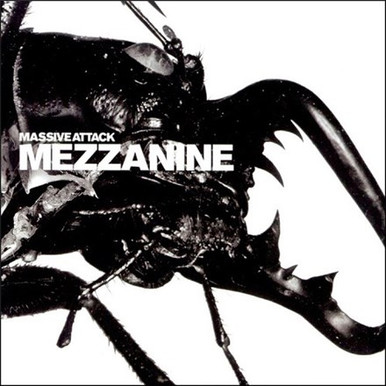
I have since read reviews of the album, along with its Wikipedia entry and that of the band (collective? group of producers?) but went in pretty blind, knowing it only from its striking album art which I remember seeing on record store walls in the late 1990s, as well as this album’s prominent placement on a list of the top ten non-Radiohead albums rated by people in the r/Radiohead subreddit, where Mezzanine placed #2 (My Bloody Valentine’s Loveless, which I am familiar with, was #1).
So I didn’t really know what to expect, other than that people who like Radiohead also like it.
Tyler: I’m gonna break down my base reaction in a manner I hope is neither glib nor self-indulgent. These tunes remind me of younger days. Mid-twenties, about, fresh from a long and hectic serving shift, rolling along with a host of wired coworkers to some nu-hip bar/club/lounge in a Chicago neighborhood a few million miles from the perfectly good holes-in-the-wall near our workplace.
That sounds like smartassery, but I kept coming back to that recollection as this music unfolded. Like, an instinctual reaction that, yep, this is good for some folks, but it’s…not lost on me, but certainly not in my wheelhouse.
It also reminded me of Poe.
Travis: “Johnny, angry Johnny” Poe?
Tyler: That is correct.
Travis: Not too far off from one of my first reactions, to one of the songs with female vocals, I think “Dissolved Girl”: This reminds me of Sneaker Pimps “6 Underground.”
Tyler: Yes!
Travis: So I went on kind of a journey with this one. My first listen, as I said earlier, was daytime during work hours and it didn’t feel right. What footholds I was able to gain on it came on the songs with sung vocals, such as “Angel,” “Teardrop,” “Black Milk.” Both voices were familiar to me and gave me a human in to what is often very inhuman sounding music.
Those voices belong to longtime reggae icon Horace Andy, whose career spans from the 1970s to now–he released a pretty damn good album in 2022, produced by Adrian Sherwood, British DJ and reggae/punk advocate–and Elizabeth Fraser, of dreampop act The Cocteau Twins.
The foothold from the vocals on those songs gave me something to look forward to on further listens as I took the album in more, and the more I listened to it, particularly at night or driving around aimlessly, the more it worked for me. Five or so listens in, I fuck with this pretty hard.
Did it grow on you at all, or still leave you cold?
Tyler: Well, I gave it a late-night listen, as felt necessary. That spin definitely felt more appropriate and accessible—strange how times of day and environments can affect our reactions so potently—while still managing to put me off at times. It’s by no means an album I disrespect, and I might even come back to it on one of those wayward nights when things like Kid A and Electronic Sound sound good.
The primary culprit is the whisper-singing. Any track with that is dead in the water on this end.
Whisper-rapping?
Travis: Can you clarify which of the many vocalists (or a particular track) that you mean by the whisper singing?
Tyler: “Mezzanine” is in my ears right now, and it qualifies. “Whisper-singing” is a wrongheaded phrase. Hushed rapping?
Travis: British talking-core?
Tyler: That’ll work.
Travis: I believe the culprit you speak of is producer Robert Del Naja aka 3D.
I had to use Wikipedia to tell me who all the players were, including who does vocals on which songs.
Of all the many people who do vocals on this album, his vocals are my least favorite.
Tyler: Like, he’s on track two, “Risingson.” That’s right after “Angel,” a hell of an opening track that gets me expecting Neo and Trinity to lay waste to a bunch of Agent Smiths. “Angel” slaps. “Risingson” sounds cool, but man, the vocals. Buzzkill.
Travis: I sort of an opposite experience with his vocals on “Group Four,” the second to last track. He does his thing over the front half of the song and it is just kinda…there. Then Elizabeth Fraser comes in for the second half and I’m like “actually, this song is good?”
I wouldn’t say I dislike his vocals after more listens, but the ceiling of the songs is definitely raised when Andy or Fraser are singing.
Tyler: The female vocals are very damned effective throughout the album.
Travis: Perhaps 3D is like, the journeyman point guard. He’ll give you fifteen and five assists and he won’t turn the ball over, but he’s never gonna have a Steph Curry game.
Tyler: Call him a solid #4 starter.
(Baseball. That sport we kinda hate now.)
Maybe a #3….D?
Travis: Elizabeth Fraser and Sarah Jay Hawley (vocals on “Dissolved Girl”) are our aces out of the bullpen, then.
Baseball, a sport known and loved by the British.
Tyler: I hear it’s big in Curacao.
Travis: So this album came out in 1998. It was huge in Britain, debuted at number one and went platinum. I feel like it never really made an impression in the US, maybe some music videos on 120 Minutes, maybe? Trip-hop and other British electronic music had moments here, but never like in England, I’m guessing.
Like, I’m sure the hot 25 year old girl who worked at Streetside Records in Webster liked this, but it was that type of album, not even a crossover success here like, say, Prodigy or the Chemical Brothers.
RIP Streetside Records in Webster, you are now a bar and grill that has white blues bands play.
RIP Streetside Records in the Loop, you are now a Noodles & Company.
Tyler: I know that Loop corner. I bought Heartbreaker at that Streetside.
Travis: When this album came out, I was not entertaining the merit of any electronic music. I was fully in the mindset that if you didn’t have a standard rock band lineup of guitar, bass, drums, and maybe a keyboard, your music was trash. Just really listening to the Misfits and Dead Kennedys. So even if this had crossed my ears at the time, I probably would have dismissed it immediately. That makes me glad I heard it now, as opposed to then.
Tyler: Yeah, very few eras in the the history of Tyler would be soundtracked by Massive Attack.
I don’t want to undersell appreciation for these jams. They uniformly sound, at worst, intriguing.
Travis: The production is immaculate, and for something that’s 25 years old now, still sounds pretty fresh.
Tyler: It’s got a real hypnotic streak.
Travis: It mixes sampling, drum machines, and live instrumentation seamlessly, and as we’ve talked about a lot when reviewing various albums, it has a very distinct atmosphere. If Dylan’s Time Out of Mind is a fictional juke joint in a David Lynch world, Mezzanine could be a strip club in Tokyo in the year 3000 or something like that.
Throughout, there’s this underlying sense of tension and maybe paranoia, and that drawing out of the tension makes the few moments of catharsis, such as when the guitars hit on “Angel” or “Group Four,” all the more rousing.
Something else that this album made me think of is that the British are much better at naturally incorporating elements of Jamaican music into their shit than Americans are. From the Clash and the Ruts mixing punk with reggae, to the Two-Tone ska bands, British multiracial reggae acts like Steel Pulse and pre-Labour of Love UB40, to albums like this that incorporate a ton of dub influence and slowed down dancehall rhythms, it all feels genuine.
The presence of actual Jamaican immigrants at the nexus of every British underground musical movement after say 1965 probably has a lot to do with that, but it’s still striking to me.
Tyler: It does feel very genuine. Mezzanine tries on different colors and costumes, but it’s not artifice.
You’ve got a solid thing going with this album. Think it’ll stay in rotation?
Travis: I do. Probably mood-dependent–this is not an all-day banger. I’m also interested in exploring more in this vein–this whole era of British electronic is basically a blank slate for me other than stuff that briefly got big in America like the Prodigy and Chemical Brothers. As such, it’s hard for me to recommend any further listening for readers who like Mezzanine. I guess Radiohead’s more electronic stuff is as close as I could come?
Tyler: I’m in the same boat. “Where Do I Begin” by the Chemical Brothers and an absurdly uncredited Beth Orton is where my knowledge of the genre begins and ends. Well, they did two with Noel Gallagher, too. That’s about it.
Travis: The Prodigy’s “Firestarter” and “Breathe” were pretty common hockey arena songs for a little while. The 90s were a strange time to be alive. End of history and all.
Tyler: Our childhoods! What a time.
 Writers' Loom