Tyler: We’re about to break down some Presley son
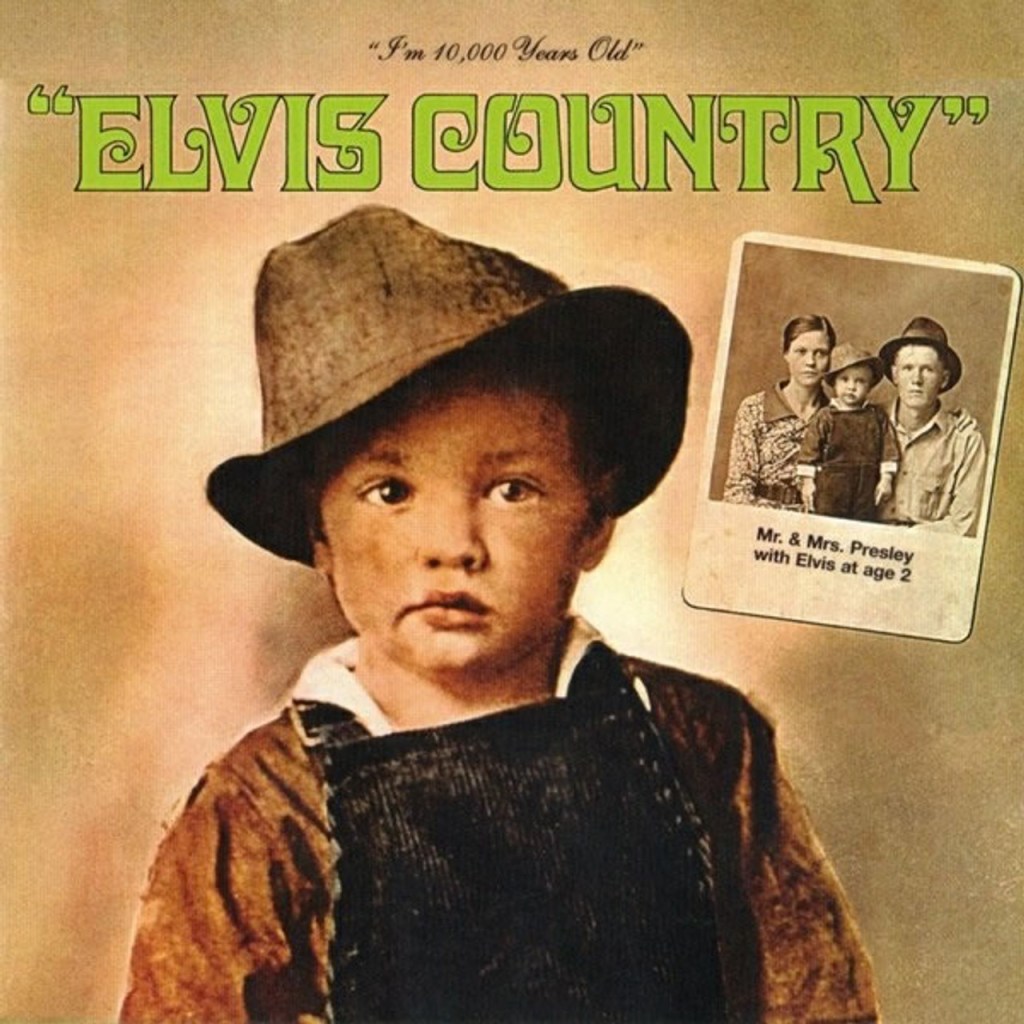
Travis: ELVIS COUNTRY
Elvis Country, the country album, by Elvis.
It just makes sense.
Tyler: Certainly sounded good to me. Much love for this one, I take it? It’s not often I’ve seen recommendations for Elvis work outside of the ‘50s.
Well, minus the comeback special.
Travis: I like this album quite a bit, yes. I’ll start off by saying that though he is primarily thought of as a singles artist, Elvis Presley has by my count five great albums (give or take one’s opinion about his well-loved Christmas disc) and Elvis Country is the last of them. After his time in the army, Elvis was pretty much beholden to his movie roles and songs chosen for him by Colonel Tom Parker, written by writers who cut Colonel Tom in on the royalties. While there were some great songs from the Elvis movie era (“Viva Las Vegas,” “Little Egypt,” and “Bossa Nova Baby” being some I like) it was pretty much a fallow creative period for him. His renaissance came with and after the comeback special you mention, which allowed him to be a stripped-down rock and roller once again.
Following that special, he made two albums over which he had at least close-to complete creative control. One is the brilliant From Elvis in Memphis, his Memphis R&B/soul album, which is possibly the best blue-eyed soul record of all time. The other is this one, Elvis Country, recorded with a combination of the top Nashville session musicians at the time and the same Muscle Shoals Rhythm Section that backed Aretha Franklin.
For this one, Elvis picked the songs, irrespective of the writers and their allegiance to Colonel Tom, wanting to create a country album that spanned the breadth of country at the time, from rockabilly and bluegrass to a heavy dose of Nashville Sound Countrypolitan.
So, what say you, Tyler? Elvis Country?
Tyler: It’s great!
I’m not familiar with most of Presley’s work, and wasn’t quite sure to expect from an Elvis country LP from the early ‘70s. Given your support of it, I had hope.
It sounds fantastic—that grand musicianship you highlight—and Elvis vocally is on point. This is a deeply talented interpreter at work right here, and the performances, the production match that talent.
Travis: Hell yeah. I thought this one might be up your alley.
Tyler: You thought right. I love country, country done right, and this work is right. I mean, the interludes alone are worth the price of admission, as they say.
Travis: The CD version of the album has the full track of the song used for the interludes (the traditional “I Was Born 10,000 Years Ago”) appended to it. I like how it’s used on the album but it’s also fun to hear it as a full song. Elvis and the band tear into it just like they did on the rest of the material.
Tyler: Righteous.
Travis: I have long discarded the CD version though, as I was able to find both this one and the aforementioned From Elvis in Memphis at the Record Exchange, a rather intimidating used record store that takes up the entirety of a defunct St. Louis Library branch in South City.
Tyler: That’s a baller-ass record store.
Travis: As you can imagine, these dudes sound good on vinyl.
Did any tracks stand out to you? Any particular favorites?
Tyler: “Tomorrow Never Comes” is something else. Like, a show-stopper right there.
The guy knows how to withhold and when to really let it rip. He belts when the moment arrives here. I love it.
Travis: “Tomorrow Never Comes” begins my favorite stretch of the album. “Snowbird” is fine and well done, but the album really kicks into gear on “Tomorrow Never Comes,” and then the momentum builds with “Little Cabin on the Hill” and “Whole Lot-ta Shakin’ Goin’ On,” which I can’t help think Elvis recorded just to show Jerry Lee Lewis he was still the King. I dare say I like Elvis’s version better than the JLL classic, because it’s such an obvious “we are gonna let it rip and see what happens” cut. Was done in one take live.
It kind of reminds me of the portions of the Get Back documentary where the Beatles would just be loose and jamming on some old favorites. Love to hear the pros fuck around on a classic and tear shit up.
Tyler: I’m a fan of “I Washed My Hands In Muddy Water.” That’s a hot jam right there.
Travis: Yeah, that’s another favorite of mine. I think you can really hear the sort of Muscle Shoals country-soul flavor on that one. Just a powerful rave-up. Honestly, I wish it closed the album. If there were two cuts I had to make, it would be the first and last song. Slimmed down to 10 tracks I think this would be a perfect record.
Like “Snowbird,” I think “Make the World Go Away” is fine, mostly due to the vocal performance, but I think “Tomorrow Never Comes” does the same kind of thing better.
Tyler: Fair point.
“Snowbird” has an almost silliness to it. That jaunty line kicking things off and accompanying the vocals. It’s a bit goofy.
Travis: It was an Anne Murray hit! I have no idea why Elvis wanted to include it. It and “Whole Lot-ta Shakin'” were the last two songs they recorded.
Tyler: What a random selection.
I’ll tell you, even with “Songbird” and “Make The World Go Away,” this is an impressively tidy album. Not even forty minutes. With “10,000 Years” knitting it all together, things almost feel like a short suite.
It also stuns me that this one isn’t more widely known and beloved.
Travis: I think part of its relative obscurity is that it doesn’t have a definitive “Elvis song” on it. Even From Elvis in Memphis has “In the Ghetto”, which pretty much everyone knows well enough to hum or recognize. As opposed to his two albums from 1956, where any American born from 1950-1980 or so has probably heard all of those songs.
Also, while Elvis was a massive concert draw between his US tours and his Vegas residency, radio play was going more toward singer-songwriter type material in 1970-71.
I also think by 1970 or so people were already well into the boring and tedious “Elvis just stole black music” backlash that still pipes up on social media once every couple of years. I could rant about that uneducated BS all night.
Whatever negative aspects Elvis had (weirdness with women, painkiller addiction, etc), he was not a cultural appropriator. He loved soul, R&B, rockabilly, country, bluegrass, and blues, and when he had creative control, which he did very early in his career and for that brief period around the comeback special, he recorded what he loved and put his own spin on it.
I should also note Elvis’s other love. Even at the depths of his most tedious movie soundtrack hell, he still recorded gospel albums with vocal groups like the Jordanaires and the Imperials (who appear on Elvis Country on “There Goes My Everything”).
Tyler: I dig the gospel on display throughout Elvis Country.
Travis: Back on the subject of the album, I’ll note a couple of my other highlights. “The Fool,” which I would say is probably the sexiest song on the album, was a rockabilly hit around the time Elvis was first coming on the scene. An early songwriting hit for Lee Hazlewood, who’d have greater success teaming with and writing for Nancy Sinatra. “Faded Love” is a Bob Wills western-swing song which I feel like Elvis and this gang turn into almost hard rock without losing that swing vibe. And “It’s Your Baby, You Rock It” is the only song written specifically for this album, but I think it fits right in vibe-wise.
Tyler: “Faded Love” has a bit of a snarl, that lead guitar line.
“It’s Your Baby, You Rock It” does fit. I would not have picked it out as an original composition. Actually, given the slightly offbeat title, I had it pegged for a cover.
Travis: Winding up the discussion, I’d say that the next place to go after Elvis Country is From Elvis in Memphis, which I’ve talked up quite a bit already. The bunches of live Elvis albums are pretty hit or miss so I’d say avoid those even if they are laden with hits. Elvis is Back! was his first LP after his army stint, and is sort of his closest thing to a straight pop-vocal Sinatra thing, but it’s also very good and has “It’s Now or Never.” Either of the two LPs from 1956 (titled Elvis Presley and Elvis, respectively) is straight bangers. There’s also a CD-era collection called Elvis ’56 which collects both of those LPs and non-album singles and shows just how insane his run that year was. I’d say of about 20 songs on it, 15 are rock and roll standards. Lastly, his early Sun records singles, his rawest material, are hard to find in their original form but they’re collected on For LP Fans Only and A Date With Elvis, which are easier to come across.
I should also say I’ve long had a soft spot for Elvis. My mom is a fan and I grew up hearing his music around the house, and went with her and a couple of her friends (one of whom has since passed away) down to Graceland when I was probably nine or ten. I come by the Elvis love honestly, but as a music fan I really do think that at his best, there were few that could match him as a singer and interpreter of just about any form of American roots music.
 Writers' Loom