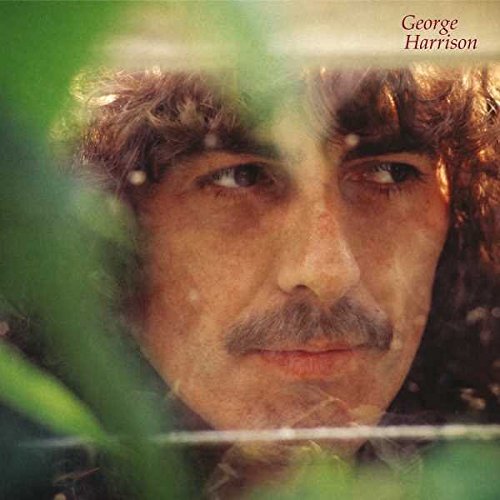
Tyler: Well, Peter, here we are at George Harrison’s eponymous 1979 LP, and boy howdy is it a creative anomaly in the career of the quiet one.
This is yacht rock—and damned happy yacht rock at that.
Peter: Yeah it’s very distinctive. So, I picked the last album. You picked this one. Had you heard it before? Or, why did you pick it? Just for some background. I’d never heard it.
Tyler: A few years back, at the peak of a record-collecting stretch, I dove into all the solo Beatle albums that I’d previously avoided or overlooked. There’re gems to be found all over the place, and this album is a strange little highlight in George’s discography. His was an inconsistent post-Beatle career. 1970’s triple-album classic All Things Must Pass is essential, but it cast a long shadow over any efforts Harrison would make in its wake. That included a rather good ATMP 1973 follow-up, Living In The Material World, and then some tough sledding up until the sprightly 1976 release Thirty Three and 1/3. That album is okay, I guess. I’ve never really returned to it. Flash forward three years to ’79, though, and I’m hooked by this optimistic eponymous package of cheese.
Peter: I was under the impression it wasn’t very good, and I just never checked it out. I don’t want to ruin the surprise, but, *spoiler alert*, I liked it.
Tyler: Isn’t it a delight?
Nowhere else in the guy’s catalog is there something this unabashedly sunny. George was a cranky sumbitch!
Peter: Yeah, it’s really quite good. George was always sort of sour. “Swing, baby! You’re platinum!”
Tyler: I mean, the first Harrison-penned track the Beatles released was “Don’t Bother Me.” Off to the races from there.
Peter: I feel like he sometimes sabotages his own songs.
Not here, though.
This reminds me of a Paul solo album. It’s very agreeable.
Tyler: It’s easy on the ears.
Peter: Opener “Love Comes To Everyone” is inoffensive, slick, 70s rock. It’s a fine tune. I like this track. We had an “easy listening” radio station they’d play at the dentist’s office when I was young. This sounds like that.
Tyler: If I recall correctly, Harrison friend and noted horrific person Eric Clapton plays like a bar on the intro and disappears for the rest of the album.
Peter: I saw Clapton was on here, but I didn’t know where.
Steve Winwood, too.
Plus some big studio musician types.
Tyler: George loved him some Willie Weeks. In geek circles, there’s known a quote wherein he disses Paul’s bass playing in celebrating Willie’s.
“Love Comes To Everyone” is pristine. The only thing that lessens it in my estimation is that it’s almost too damn optimistic. Does love come to everyone? I dunno about that.
Well, pristine in that it’s polished to a shine and immaculately produced. Everything in its right place.
Peter: Agreed, but there’s a guitar solo on here that’s clearly George because it’s not good enough to be a studio musician. Lol. It actually adds a bit of grit to an otherwise pretty glossy production.
Tyler: George never could grip it and rip it solo-wise, that’s true. I will pimp the guy’s slide playing, though. He got a serious handle on that over the years.
Peter: I’d take him on slide, for sure.
I knew the next song, “Not Guilty,” because it’s a leftover from the Beatle days. We heard it on Anthology 3.
Tyler: It’s a pretty clear shot across the Lennon-McCartney bow. I never took to the Beatle version—it’s such a grind, and George’s vocals are buried and weak. The contrast is massive, between that cut and the soft-jazz rendition we’ve got here.
Peter: I actually prefer the Beatles version! But this one’s not bad. The lyrics do seem aimed at John and Paul.
His vocals are better on this one.
Tyler: They’re pronounced. I never could understand why the Beatles muffled his delivery on it.
Either way, it’s the only dark moment on George Harrison, and it’s not even that dark, given the light approach.
“Here Comes The Moon.” Sequel song!
Peter: Fun fact: George wrote a song called “Here Comes The Sun” when he was a Beatle.
(Not sure if everyone knew that.)
Anyway, it feels gimmicky, but this is a fine song. It’s pretty.
It’s a good tune. Hard to dislike.
Tyler: I agree. It’s charming.
“Soft-Hearted Hana” slaps.
Just, goofy as all get out. Inspired by a mushroom trip.
Peter: “Soft-Hearted Hana” sounds like George channeling Paul to me. It’s well done. This is another winner for me.
Tyler: It’s got a real “Famous Groupies” thing going on, and I think “Famous Groupies” is one of the best Paul songs ever.
Peter: I think George admired Paul very much.
Tyler: It was tough to watch Get Back and see George trampled underfoot—or so he saw it.
Peter: I couldn’t watch Get Back.
Tyler: No Disney+ or other reasons?
Peter: I started it, but the tension in the group is still so obvious (I know they were trying to rewrite the history, but c’mon).
I think George admired Paul a lot. And also found him annoying. It was a complex relationship.
Tyler: I wish I had the source or at least the podcast episode where I heard it, but there’s a George interview out there where he describes, in the wake of working together briefly in the early ‘80s, that you can’t be “straight” with Paul. Interesting assessment.
Peter: Let’s forge ahead. “Blow Away” is more light rock. It’s another good tune. It’s aggressively inoffensive.
It’s funny. Some of the backing tracks are quite saccharine, but George’s voice sort of saves them from being *too* perfect. I mean, I don’t dislike George’s voice. It’s fine. But he’s not a great singer and that adds a bit of edge to the songs. A little sour with the sweet. Rough with the smooth.
Tyler: It absolutely doesn’t fit what you’d expect to be vocally paired with arrangements like these.
Peter: Yeah, exactly.
Tyler: “Blow Away” has a tremendous video that looks like it was made for about five dollars. At one point a giant image of a rubber ducky shows up. I believe I saw this thing on VH1 on an oldies show hosted by David Cassidy.
Peter: That sounds amazing.

Tyler: We’ve next got the silly, silly-ass “Faster.” It’s kinda great.
Peter: I have a lot of thoughts on this one.
Okay, George liked Formula 1 racing. I find this funny. No offense to people who like that sort of thing. Anyway, this is his tribute to that and I had a really hard time taking this song seriously. I’ll just say, it’s not terrible, but the revving cars are really distracting and silly.
It’s easily the weirdest track on the album. It’s got a “hard to look away” feel for me. The lyrics sort of tell a story, but it doesn’t go anywhere. There are bits like this:
The people were intrigued
His wife held back her fears
The headlines gave acclaim
He’d realized their dreams
Tyler: There’s also that legendary hook, “He’s a master at going faster.”
I dunno, man, I think I just give in to this one. It’s so dumb, but he clearly put real effort into it. There’re strings!
Peter: He’s trying so hard! It’s like he’s writing a song for his middle school girlfriend. He’s trying to impress his crush.
And yet… thumbs up?
The tune is good.
Tyler: It sounds good, y’know? It’s a bizarre lyrical left turn, but the proceedings are still lush and cozy. Something about all of this is very soothing.
He’s so earnest. Middle school poetry indeed.
Peter: The structure of it is weird. I can’t tell the chorus from the middle 8. But, yes, very earnest.
Tyler: “Dark Sweet Lady,” on the other hand, is a legitimate standout. You don’t get many love songs from George that’re this straightforward. Most of the time he’s writing cryptically—his love songs could be about both women and God.
Peter: Agreed. “Dark Sweet Lady” is good. We’re back on track. Look, this album is just plain good. The people of 1979 were wrong. They didn’t appreciate what they had here. It’s a pretty good Beatle solo album.
Tyler: It really is. I’m a champion of a lot of Beatle solo stuff, more than is probably reasonable. But this one I’ll defend with vigor. It’s consistent, it’s quick, and it’s damn good-natured.
Peter: It is! George is trying here. That’s something.
“Your Love Is Forever” is also good. This is a good album. Everyone is wrong about this album. I mean, it’s overly slick in places, but still.
And, yes, to your earlier point, this one seems like it’s about God. Though it’s kind of disguised as being about a woman.
Tyler: “Your Love Is Forever” straddles that line, definitely.
If you want it to fit the album that completely, then sure, call it another Olivia tune. But more generally, he absolutely could be talking about God.
I heard along the way that “Soft Touch” might be about Dhani, George and Olivia’s son, but I’m not completely sold on that interpretation.
Peter: Interesting.
It’s good. I like it.
Tyler: Same here. It’s a winner.
Peter: It has a sort of vaguely Caribbean feel. At times.
Tyler: George was big on the beach. The fucking grand posthumous LP Brainwashed features a song called “Rocking Chair In Hawaii.”
Peter: I knew he loved the ukuleles.
Tyler: “If You Believe,” then, wraps things up the way they started: optimistic and spiritual.
Peter: “If You Believe” sounds a bit like the opening theme to an 80s sitcom to me.
Tyler: Yeah, it’s cheesy as fuck. This and “Love Comes To Everyone” are just this side of too much.
But I don’t hate it.
Peter: It’s just over the line for me. A rare misstep on an otherwise solid effort!
I totally understand how this got overlooked. 1979 was part of a period of transition. George’s last album, Thirty Three & ⅓, was released about a year before The Sex Pistols first album dropped. By 1979, Punk, disco, and new wave had transformed the musical landscape. A George Harrison solo album was not guaranteed a piece of the discourse, and this album is so restrained and sweet, it failed to land.
Tyler: If it had been released a couple years later, perhaps, it would’ve found some success, considering the success of soft-rockers like Christopher Cross and Michael McDonald.
To name but two.
Peter: For sure.
 Writers' Loom